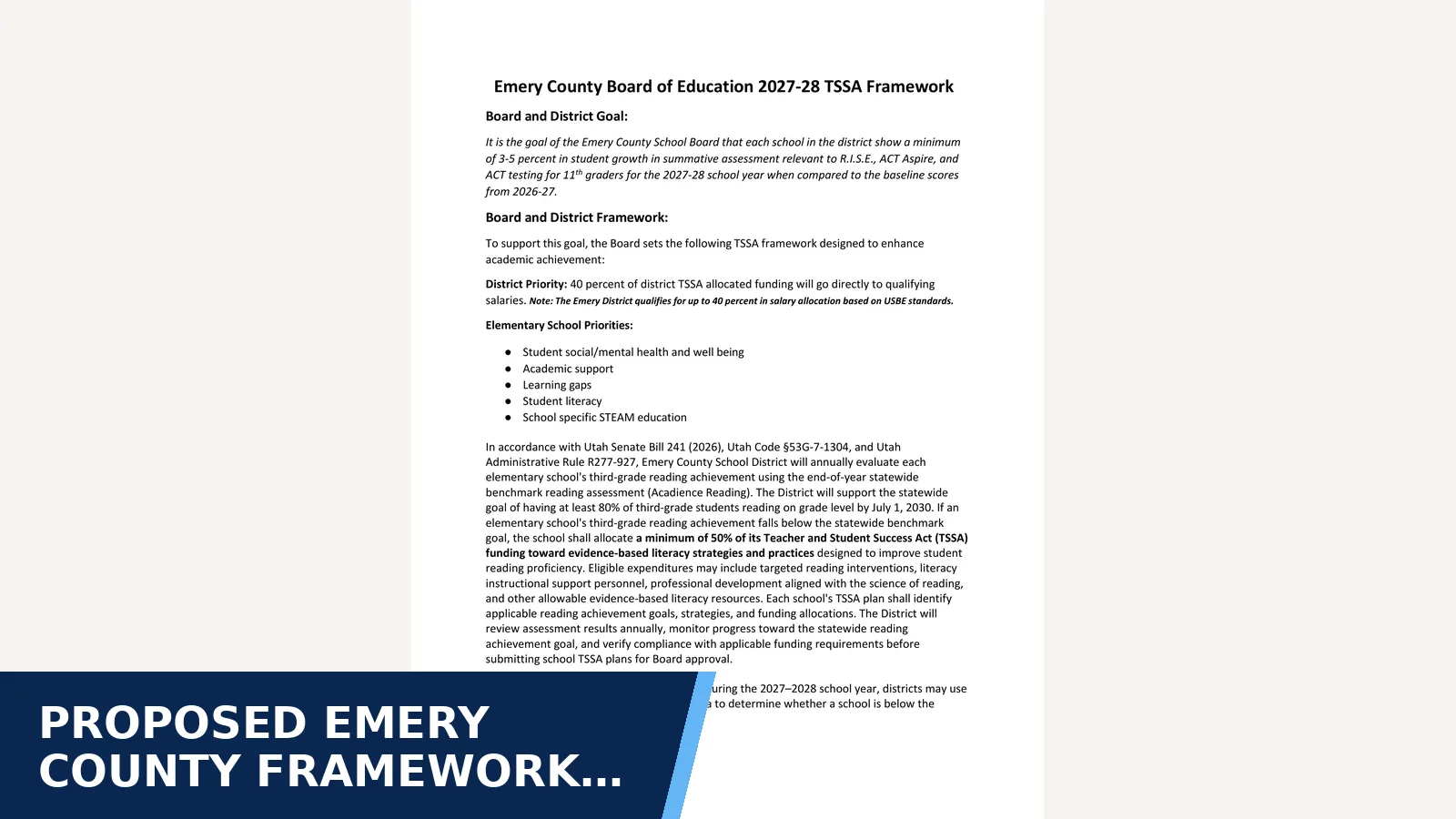
Emery County is proposing a 2027–28 framework requiring each elementary school below the state third-grade reading benchmark to spend at least 50% of its TSSA funding on evidence-based literacy strategies.
We bring transparency to school decisions nationwide by tracking school board meetings, district documents, and public data. We use AI tools, rigorously evaluated for accuracy, to search for risks.
The policy desk
What’s moving in phones
The debate over phones, screens and the school day.
The board approved applying for a state Rural Athletic Facilities grant for a $900,000 project to replace the worn six-lane track at Piute High with an eight-lane track. The plan is $500,000 from the grant and $325,000 from the district, with possible help from the special service district.
The September 29, 2026 board packet includes a draft Staff Use of Artificial Intelligence policy. Staff could use AI for lesson planning, writing drafts and research, but would have to check all AI work. They could not put protected student information into public AI tools or use AI alone to grade or discipline students. Only approved AI tools could be used with school data.
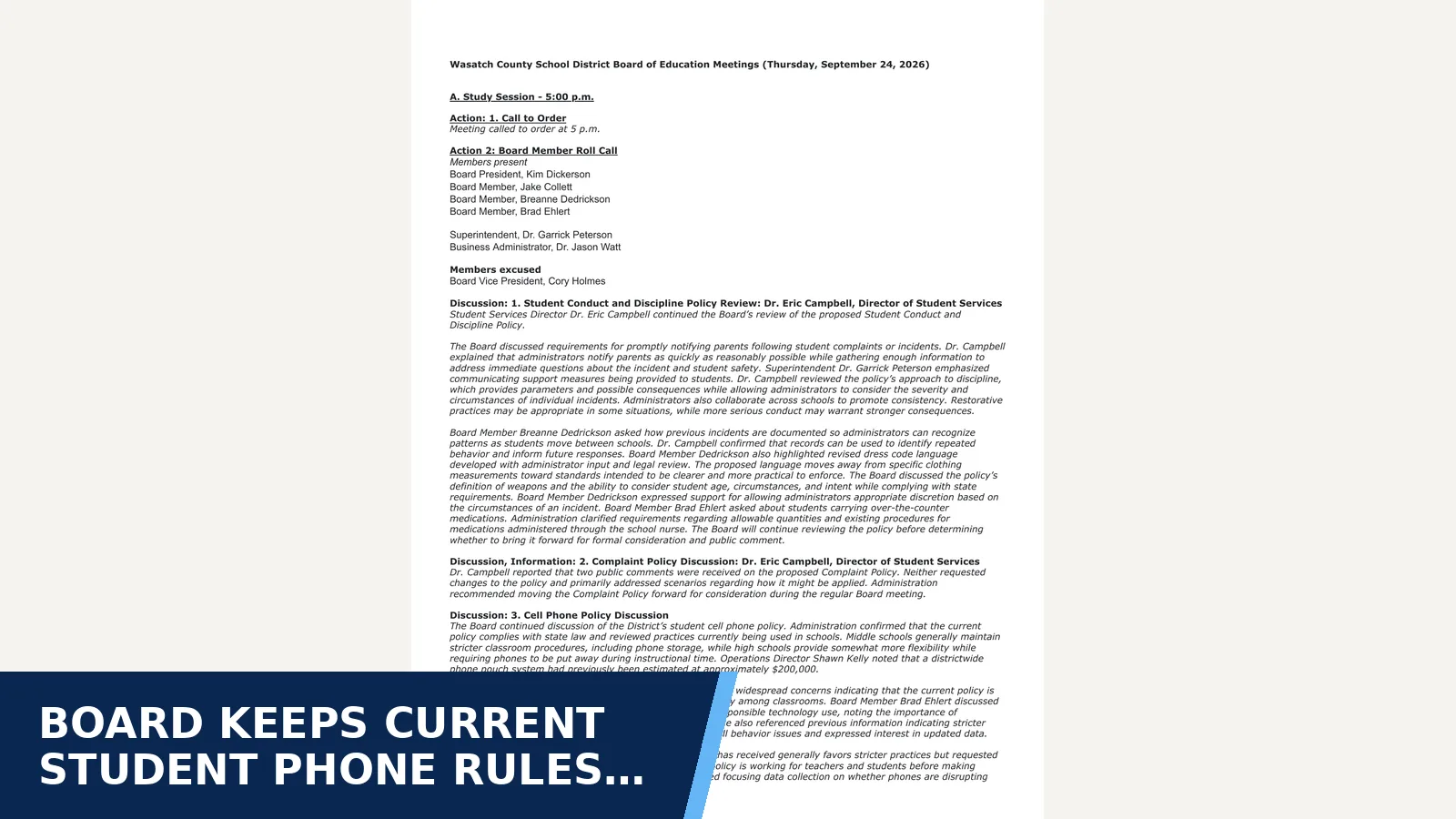
At its September 24, 2026 study session the board discussed whether to tighten student phone rules. Staff said current rules meet state law: middle schools lock phones up during class, and high schools require them put away during instruction. A pouch system for every school was estimated at about $200,000. Members asked for teacher data before deciding.
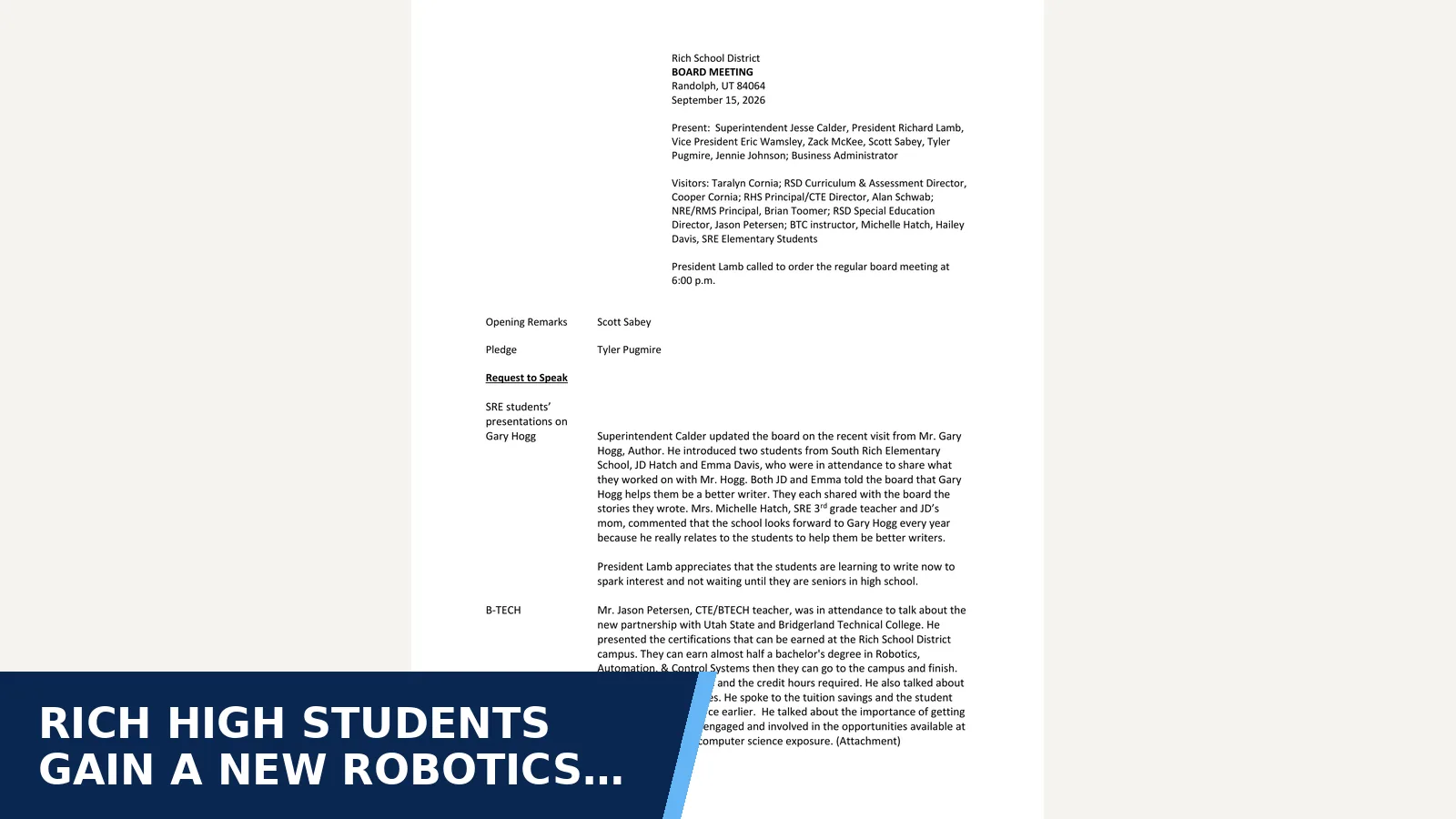
A new partnership with Utah State University and Bridgerland Technical College gives students access to training and certifications in robotics, automation and control systems at the district campus. Students can complete nearly half of a bachelor’s degree before transferring to a campus to finish it.
The district started 2026-27 with 1,805 K-12 students, down from 1,905 on October 1, 2025. In March, staff said the October 2025 count was already 12.77% lower than in 2021-22.
The board's building committee is planning the next construction project and possible bond. On September 8, 2026, the board voted to keep working on the plan with FEMA funding, ask the Town of Dutch John what it can contribute, and price fixes for the propane tank, the Flaming Gorge Elementary gym, and Manila Elementary.
On September 8, 2026, the board gave final approval to a revised Student Electronic Devices policy (FGAB). At an August hearing, the high school principal said phones have been removed from the schools, except a few cases where students need them for college classes or log-in codes.
At the August 25, 2026 meeting the director reported 317 students enrolled. Fifty students left the school, 23 of them while moving from 5th to 6th grade, though new students filled some places. Families who left named transportation and communication as their main concerns. In spring the school had expected about 358, then 339.
On August 25, 2026 the director told the board the 4th and 5th grade overnight trips are not sustainable. Fewer than half of students went last year, and cost is a problem. He proposed doing more evening and weekend field trips instead. The board did not vote on a change.
On August 25, 2026, the board voted 5-0 to adopt a cell phone policy written by the district. In July it had put off adopting the state's model policy so local leaders could write their own.
Oscarson Elementary principal Heather Fautin stepped down from that role in June 2026 and became the district literacy director. In August the board hired Shannon Gleave as Oscarson Elementary principal.
The board ended the $30-a-month preschool tuition at Oscarson and Circleville elementary schools, starting right away. The fee brought in about $4,000 to $5,000 a year.
The board raised the total budget for the new Circleville and Oscarson elementary schools to $26 million, up from about $25.5 million in April. It also approved about $2.24 million in change orders so far, including backup generators, extra playgrounds and field work, and high school paving.
In August the business administrator said Huntington Elementary's HVAC project had many delays and a delayed school start might be needed if power work slipped further. Cleveland Elementary's new system would not start until October, so old coolers stayed in use.
A new district policy (IJNDBA) makes all K-8 schools and Green River High (grades 7-12) phone-free for the whole school day. Emery High (grades 9-12) is phone-free from bell to bell during class. Phones, smartwatches and earbuds must be silenced and kept out of sight.
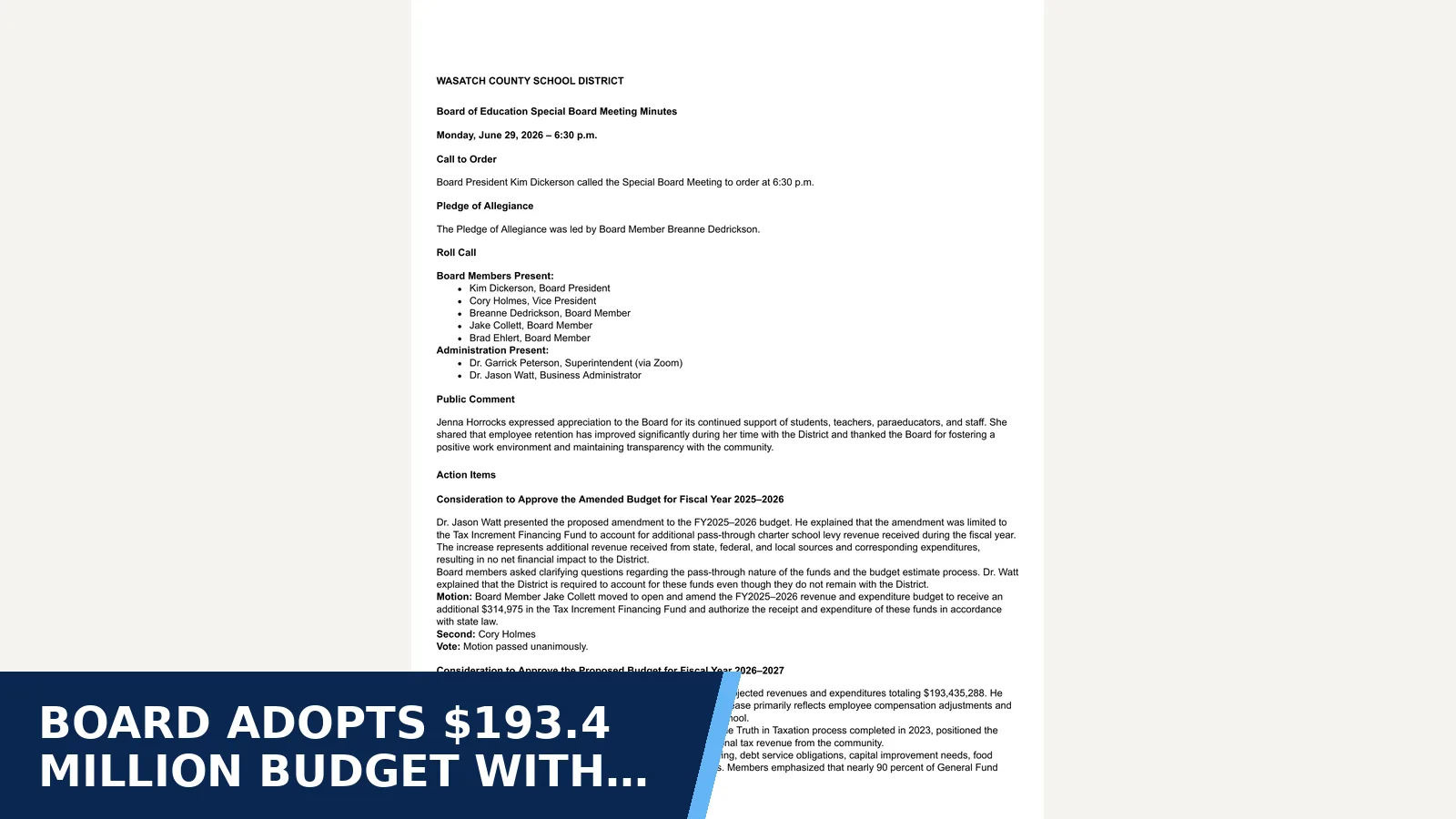
On June 29, 2026 the board adopted a $193,435,288 budget for 2026-27. Staff said raises and the cost of opening Deer Creek High School are covered without a property tax increase, crediting the 2023 truth-in-taxation increase. The vote was moved from June 16 after questions about the hearing notice.
On June 23, 2026 the board adopted a 2026-27 budget with $4.72 million in revenue and $4.71 million in spending, a $12,489 surplus. The business manager said a version built on 317 students did not balance, so he rebuilt it around 325 students. The school lost $493,185 in 2024-25 and $605,501 in 2025-26 (year-to-date actual).
On June 23, 2026 the board adopted a School Lunch and Nutrition Policy. The school does not take part in the federal school lunch or breakfast programs. Lunch is optional and comes from an outside vendor. With no cafeteria, students eat in classrooms, other indoor spaces, or outside when allowed.
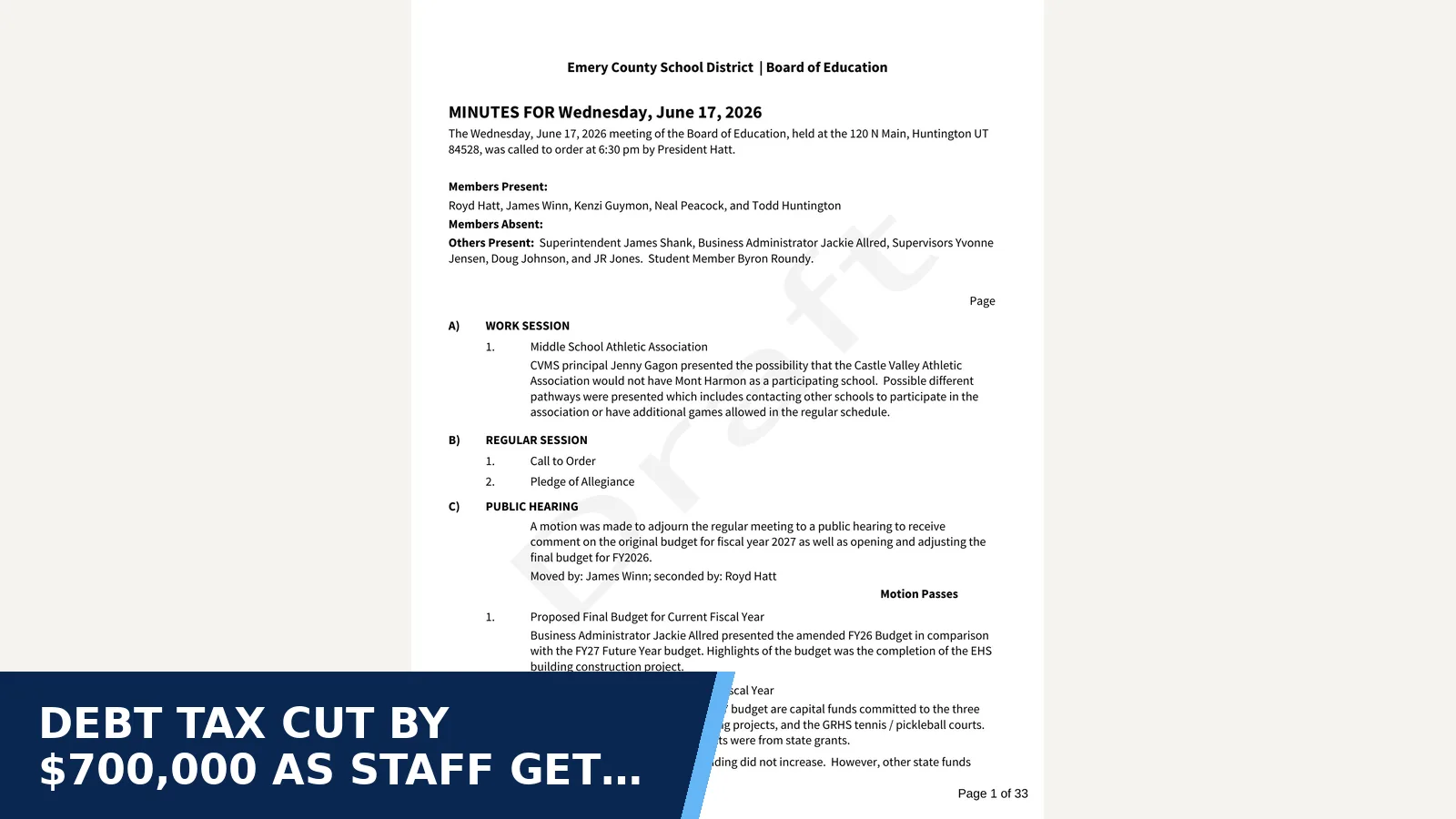
In June the board set 2026 tax rates and used solar project (CRA) money to lower the bond debt levy by $700,000. It also approved a 3.47% raise on the teacher salary schedule and 3.45% for classified and food service staff, with a 7.2% medical plan increase.
The board changed its retirement incentive policy. Long-time staff hired before July 1, 2015 now get a guaranteed $30,000 medical trust at retirement, up from $15,000. It also created a voluntary retirement program so jobs can be cut by attrition instead of layoffs, and opened it for applications until July 15, 2026.
The board adopted its 2026-27 budget on June 16, 2026. The preliminary budget approved in May included buying a new bus and a 3% pay raise for employees. In May the board also said it had missed the deadline for the Truth in Taxation process this year.
At the June 2026 budget hearing, the board unanimously authorized up to $6 million from the Maintenance and Operation Fund's undistributed reserve for current-year obligations if needed to avoid a negative balance.