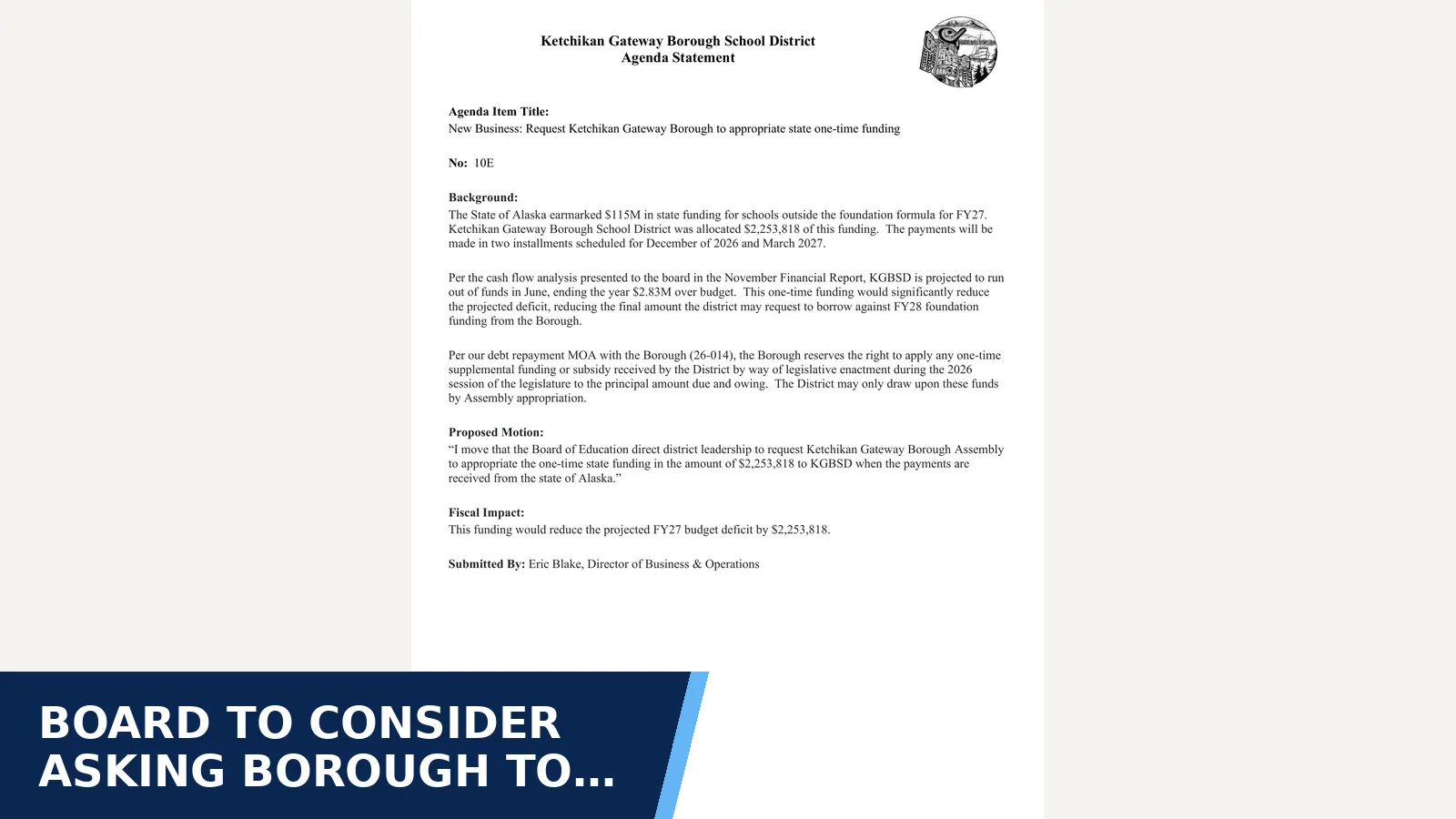
A proposed motion would direct district leaders to ask the Borough Assembly to appropriate $2,253,818 in one-time state aid to the district when the state sends the money.
We bring transparency to school decisions nationwide by tracking school board meetings, district documents, and public data. We use AI tools, rigorously evaluated for accuracy, to search for risks.
The policy desk
What’s moving in phones
The debate over phones, screens and the school day.
No recent stories in this edition. Explore the latest reporting below.
The policy desk
What’s moving in AI
How artificial intelligence is changing classrooms and school rules.
The district is proposing $4.5 million in FY26 transfers to support food service, transportation and student activities; the item is on the Oct. 27 agenda for final reading, so this packet does not establish approval. The plan allocates $2 million each to food service and transportation and $500,000 to activities and athletics, without increasing municipal tax appropriations.
The district is proposing to accept year two of a three-year Sealaska Heritage Institute grant, which would fund 2.5 Indian Cultural Specialist positions. The $216,558 in grant support is intended to ensure every JSD elementary school has a dedicated full-time specialist; the item is listed for a first reading, not as an adopted decision.
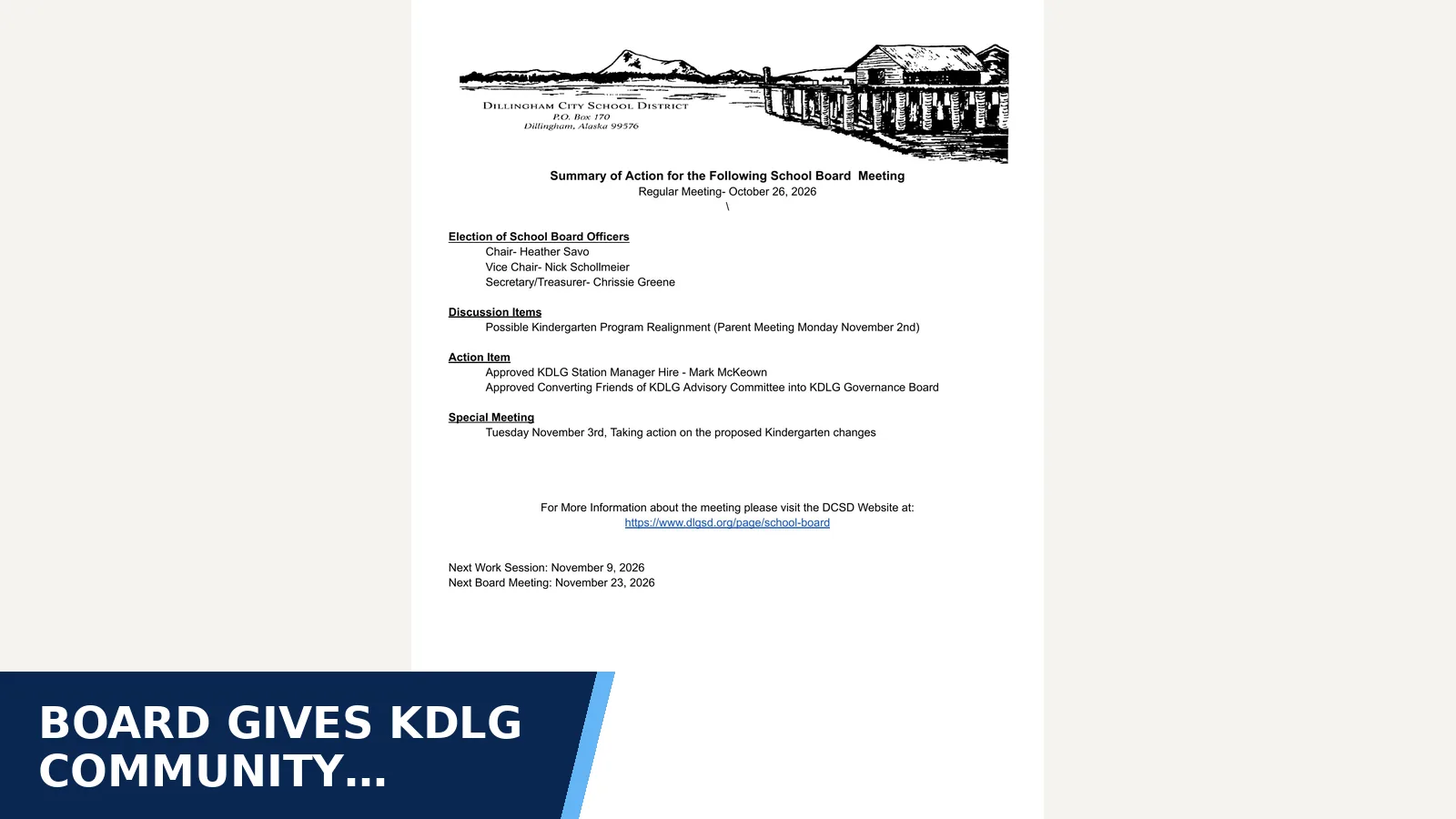
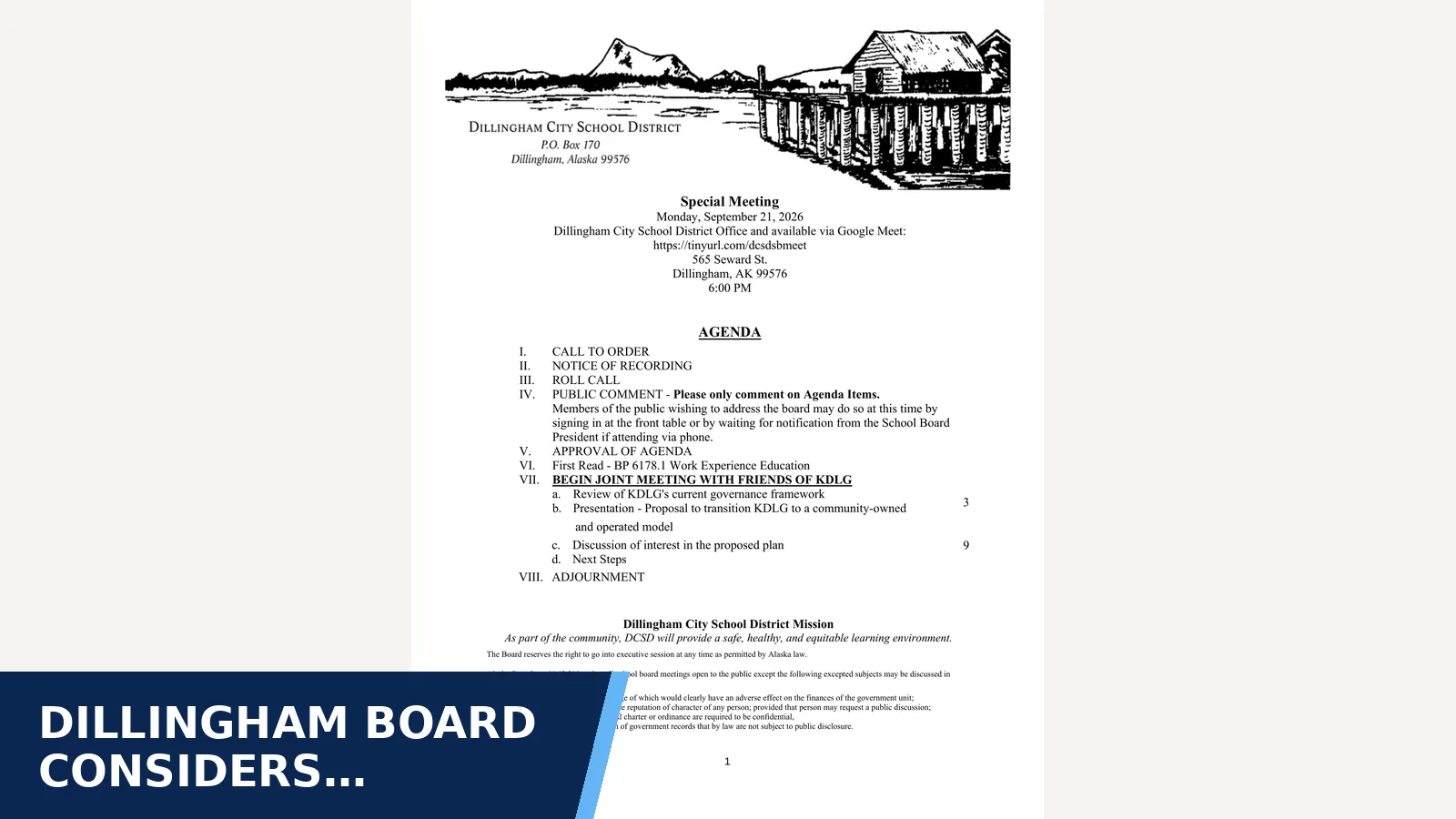
Dillingham’s board approved converting the Friends of KDLG advisory committee into a governance board. The new board is assigned responsibility for setting the station’s operating structure, meeting calendar and procedures, hiring process, strategic plan, and officers.
Superintendent Jharrett Bryantt said he will leave Anchorage School District on Feb. 1, 2027, to take a new position. The Board said it is accepting applications for an interim superintendent through Oct. 30 and is planning the search for his successor.
Kenny Lake School closed immediately on Oct. 20 because of weather and power conditions. Families were asked to pick up students if able; buses were to be available in 20 minutes, and school was planned to resume the next day.
The administration is preparing a proposed April 2027 school bond of less than about $60 million, but the Board has not chosen projects or approved a package. Its $136.5 million list of possibilities includes major renovations at Bartlett High School and Romig Middle School and roof and structural work at Wendler Middle School.
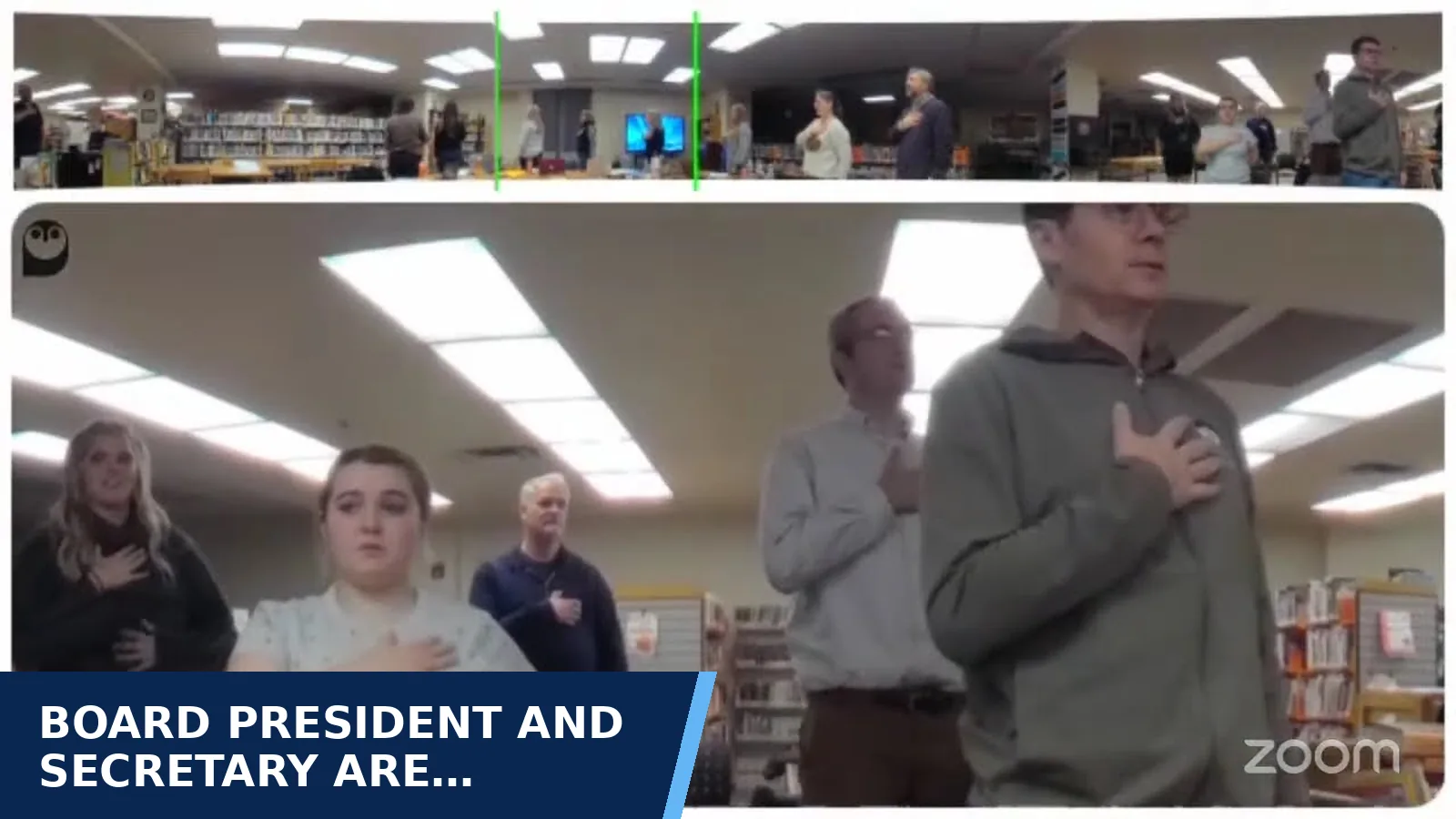
At its October 2026 meeting the board passed resolutions honoring board president Don Adams (9 years) and secretary Jenna Hamm (12 years) for their service. Their seats and a third seat, held by Katie Griebe, expire in November 2026, and the borough election is November 3, 2026.
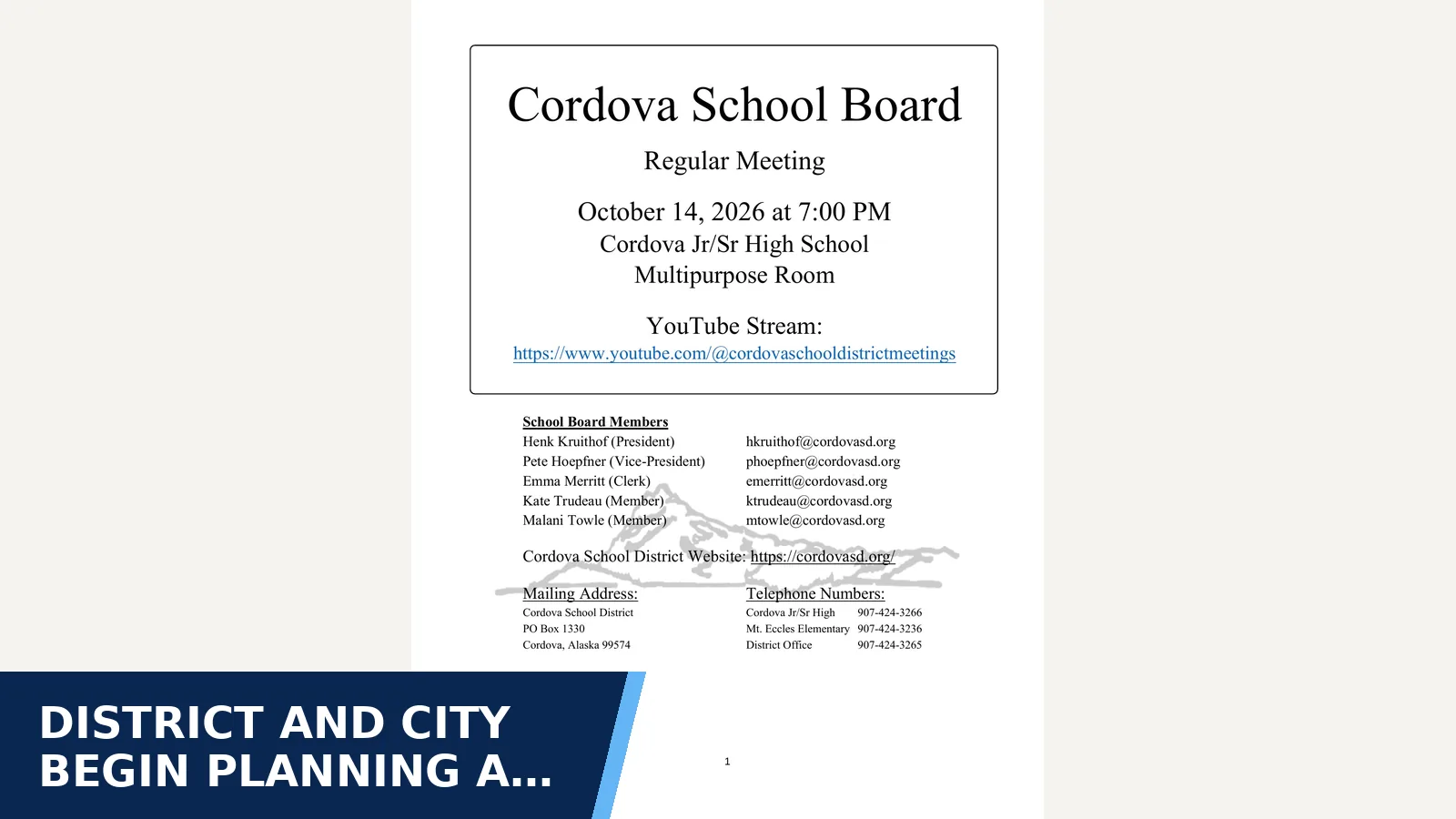
Cordova School District and the City of Cordova are beginning planning for a state capital-improvement grant application for the Cordova Jr.-Sr. High School building. The district is still weighing renovation against replacement and lists Sept. 1, 2027, as a tentative application target, calling that timeline a “lofty goal.”
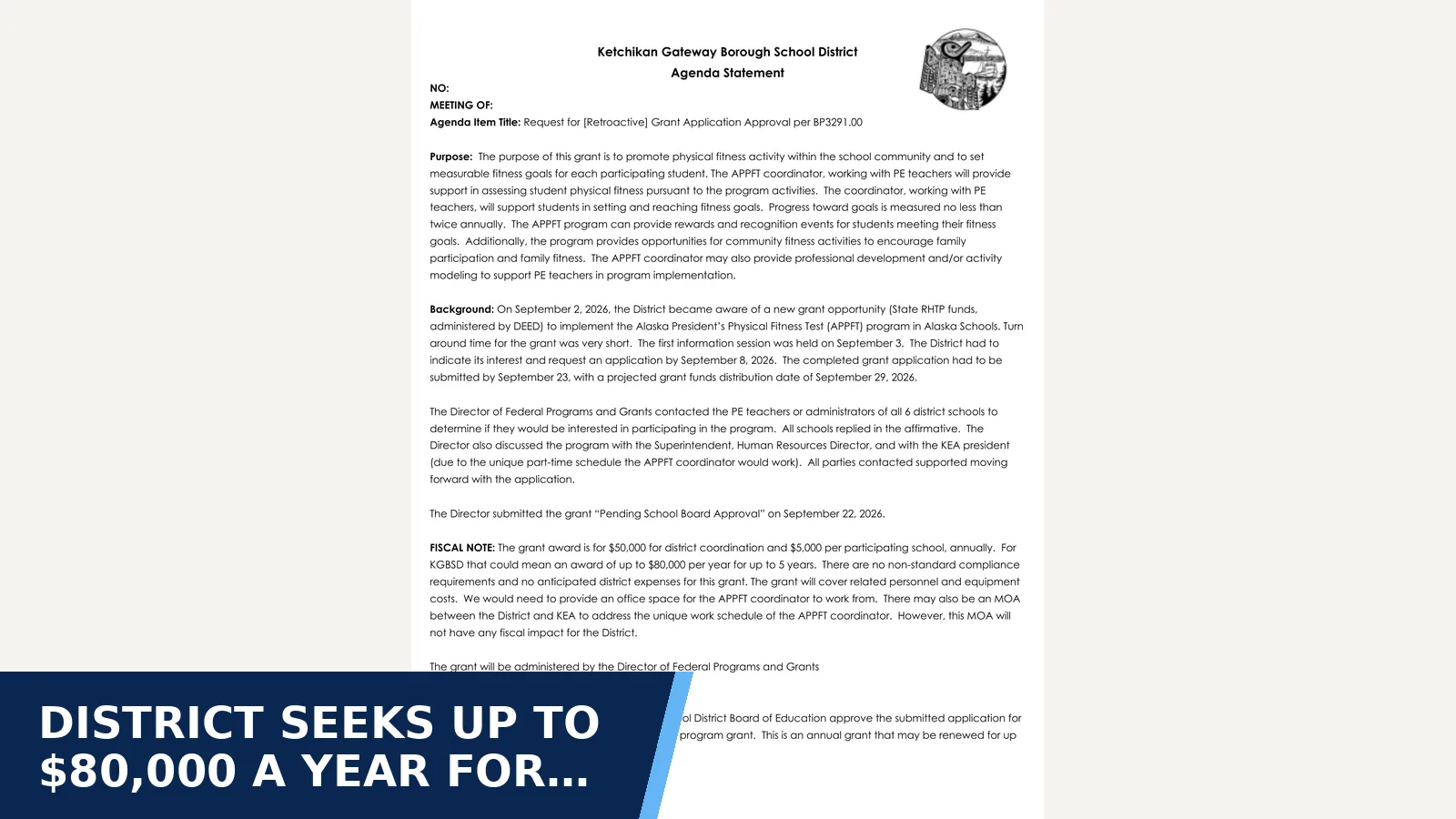
The October 14 agenda asks the board to approve the district’s application for Alaska’s President’s Physical Fitness Test program, submitted pending board approval. All schools expressed interest; the proposed grant could provide up to $80,000 annually for as many as five years for a coordinator, personnel and equipment.
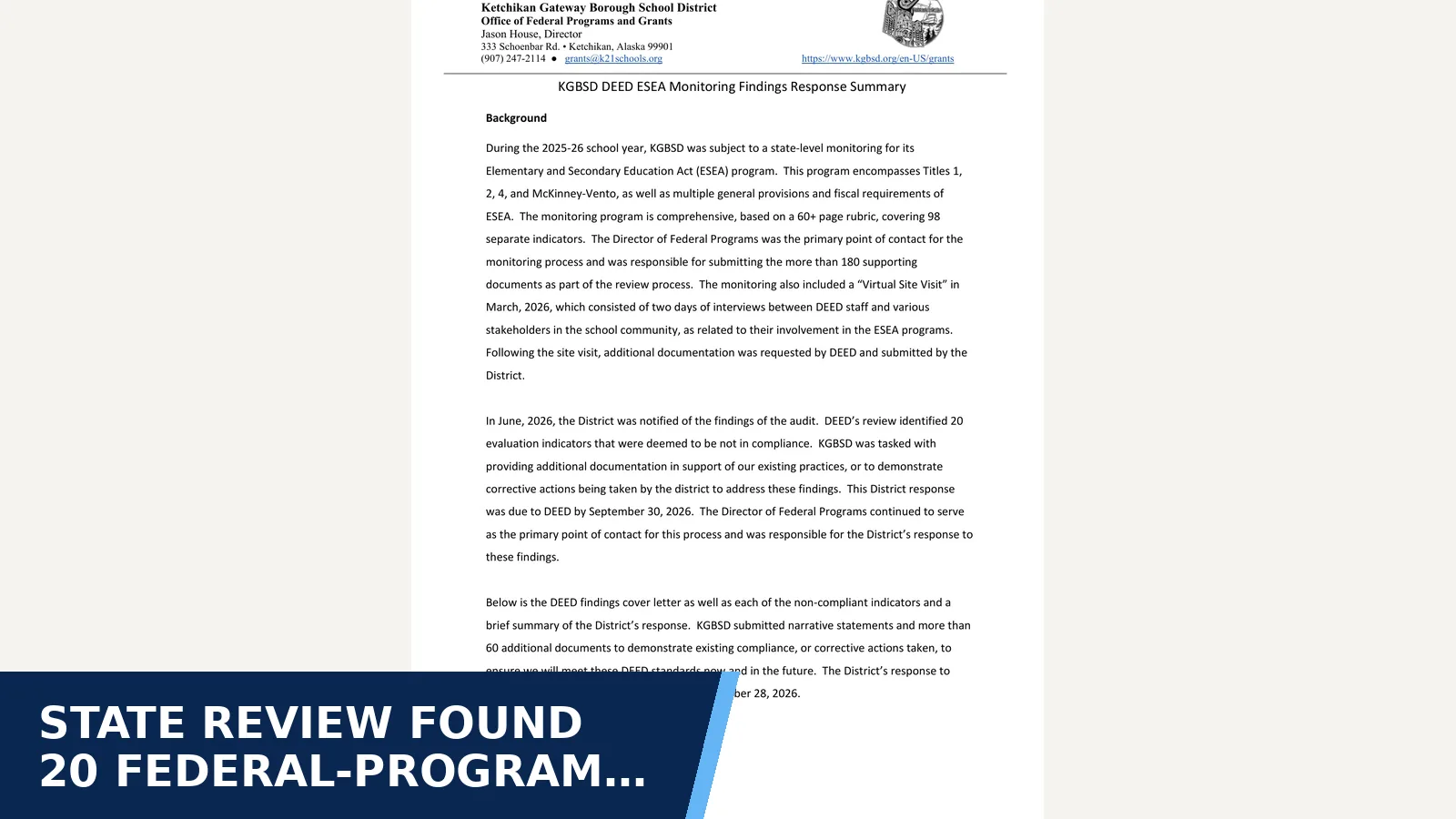
Alaska DEED’s 2025–26 review found KGBSD out of compliance on 20 indicators covering ESEA programs, including Title I, Title II, Title IV and federal fiscal requirements. The district submitted its response on September 28, describing corrective steps and more than 60 supporting documents; DEED’s acceptance is not stated in the record.
Anchorage School District reported structural roof needs at Tudor Elementary and Wendler Middle School; the affected areas are considered safe to occupy with snow-load controls. Engineers recommend keeping snow below 20 pounds per square foot while permanent structural improvements are planned.
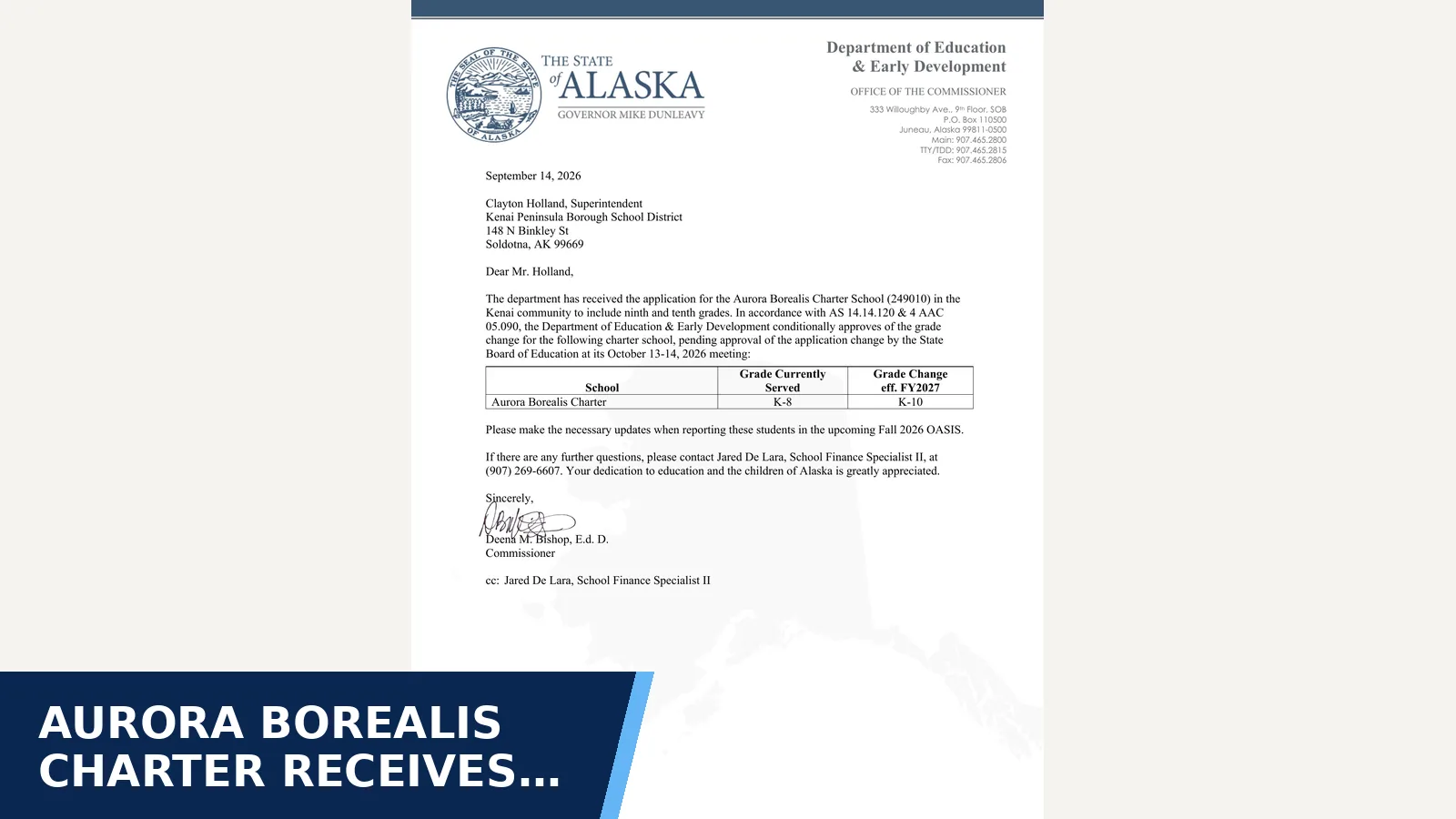
Alaska DEED conditionally approved Aurora Borealis Charter School’s expansion from grades K–8 to K–10 for FY2027. Final approval by the State Board of Education was still pending for its October 13–14, 2026 meeting.
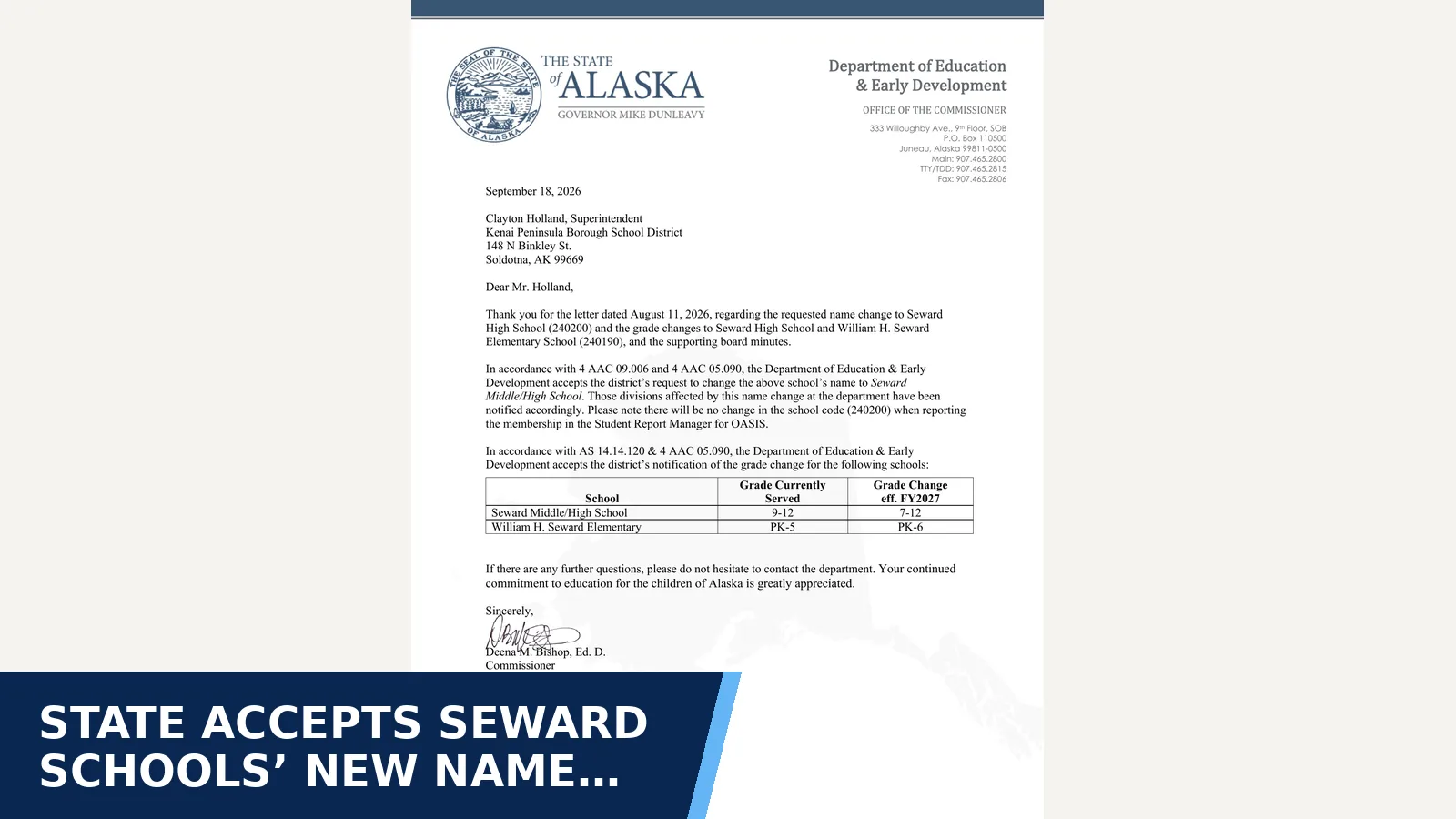
Alaska DEED accepted the district’s request to rename Seward High School as Seward Middle/High School and expand its grades from 9–12 to 7–12; William H. Seward Elementary School will expand from PK–5 to PK–6 for FY2027. The accepted changes establish a new grade configuration across the two Seward schools.
A revised application proposes converting Soldotna Elementary School into a K–6 charter for FY28, adding STREAM-focused instruction, dedicated science, music and PE specialists, and more school-level governance. It says the school would preserve neighborhood enrollment, special-education supports, district transportation and meals; the conversion remains proposed, not approved.
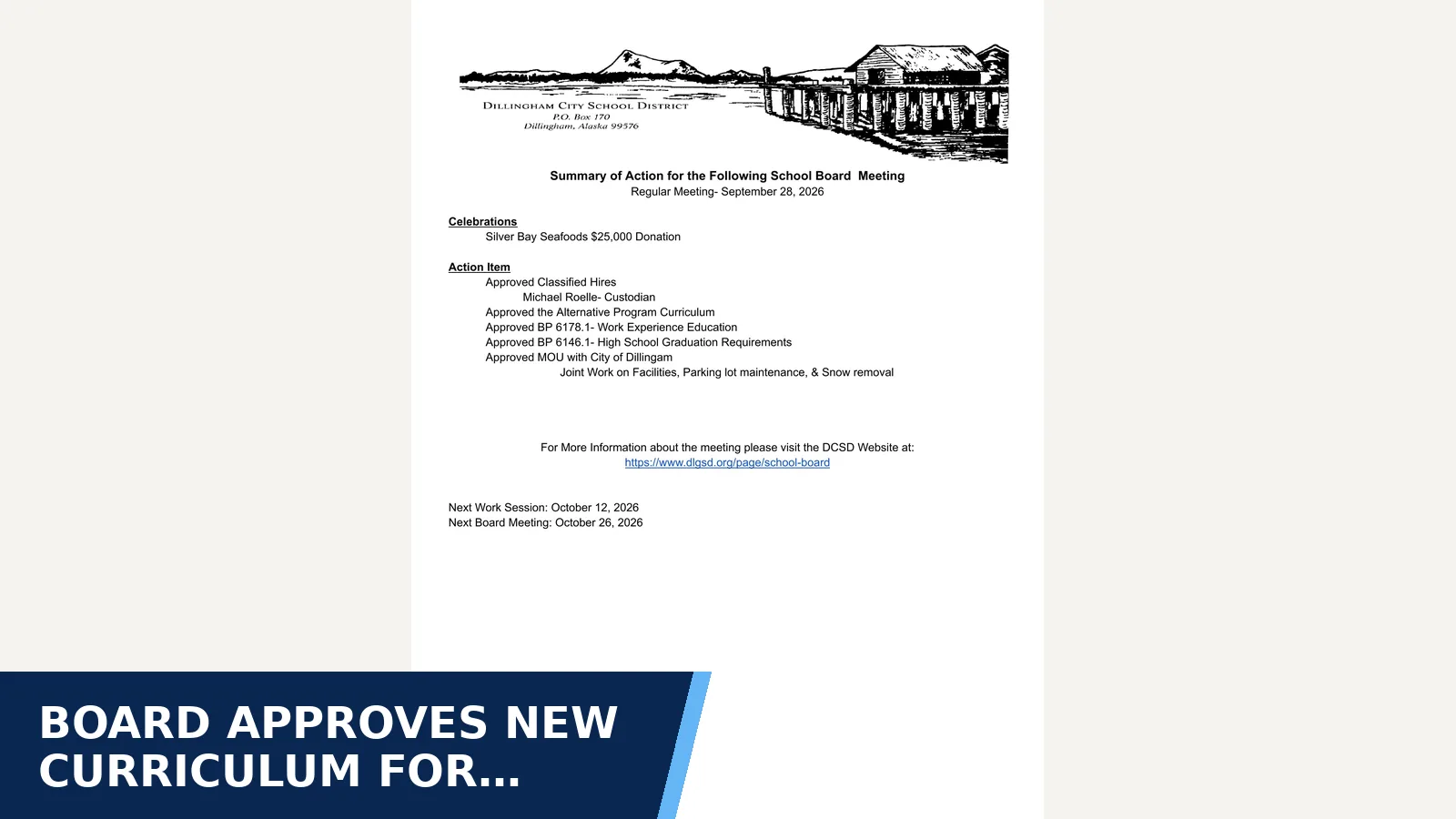
The board approved curriculum for the district’s alternative program. The package includes semester-long, half-credit English courses built around full novels, with Alaska-focused projects and self-paced module options.
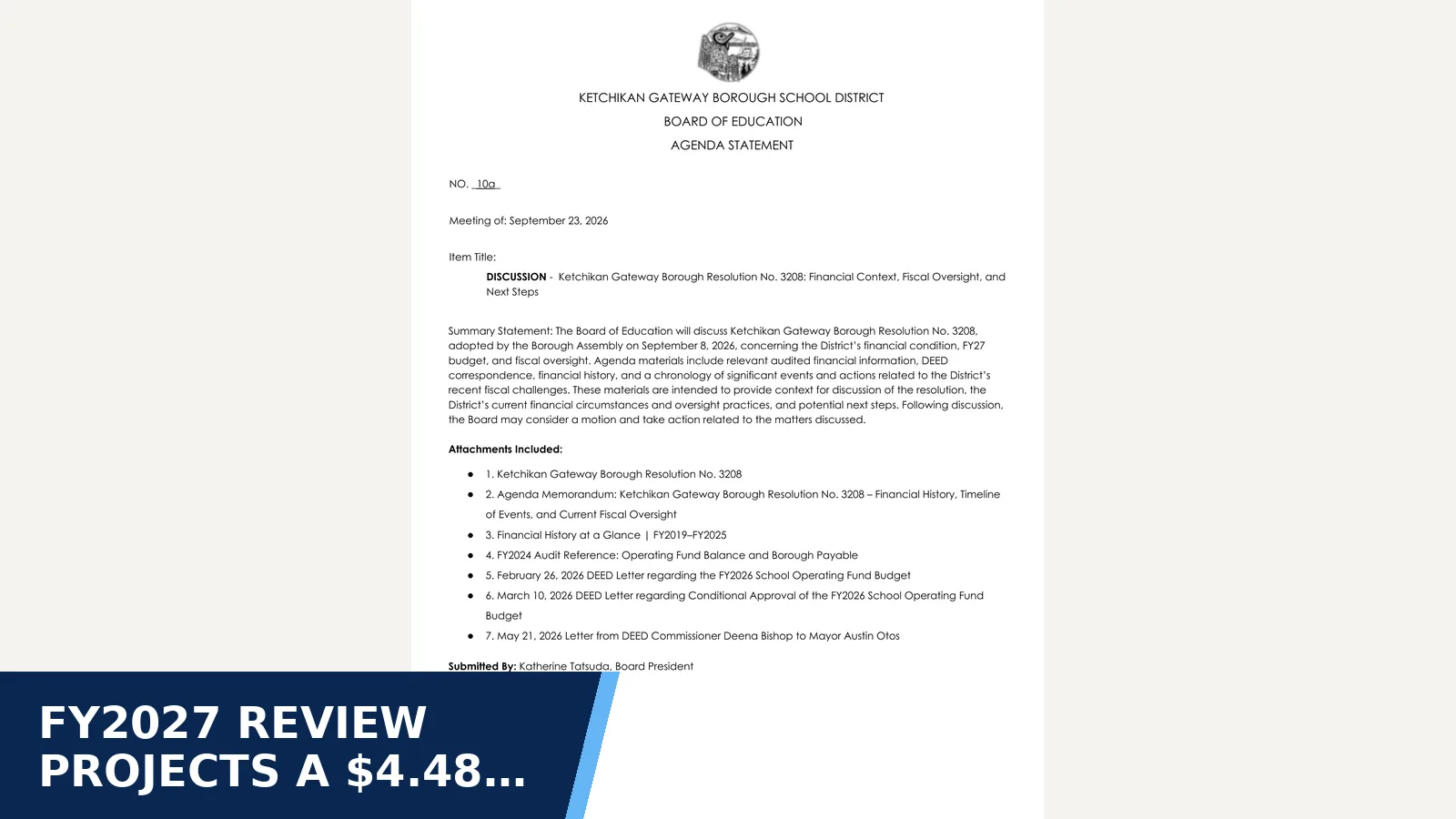
A financial review included in the September 23 board packet projected a roughly $4.48 million FY2027 year-end deficit, despite the adopted budget’s balanced projection. As of August 19, it also identified $4.28 million in unbudgeted encumbrances, $2.53 million in over-budget encumbrances and $8.60 million in additional highly likely costs; the estimate was preliminary and assumed no further unanticipated expenses.
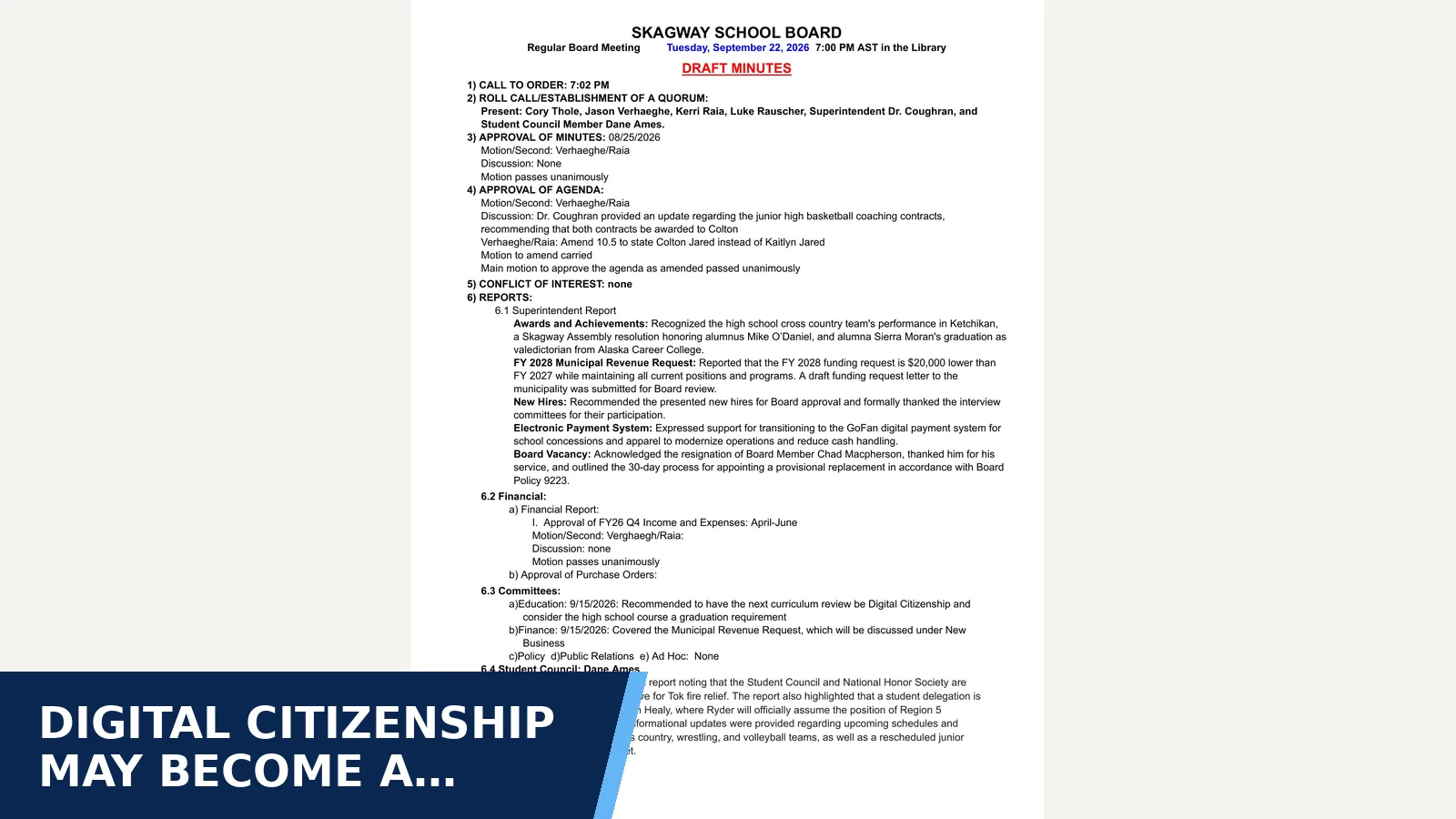
On September 22, 2026 the board made digital citizenship this year's curriculum review subject. The Education Committee floated making the half-credit high school class a graduation requirement, maybe paired with health as a ninth-grade course.
At the September 22, 2026 board meeting the superintendent said Skagway School counted about 150 students in 2022-23 and 115 last year, a drop of 35. He expects enrollment to stay between 110 and 125 for the next several years.
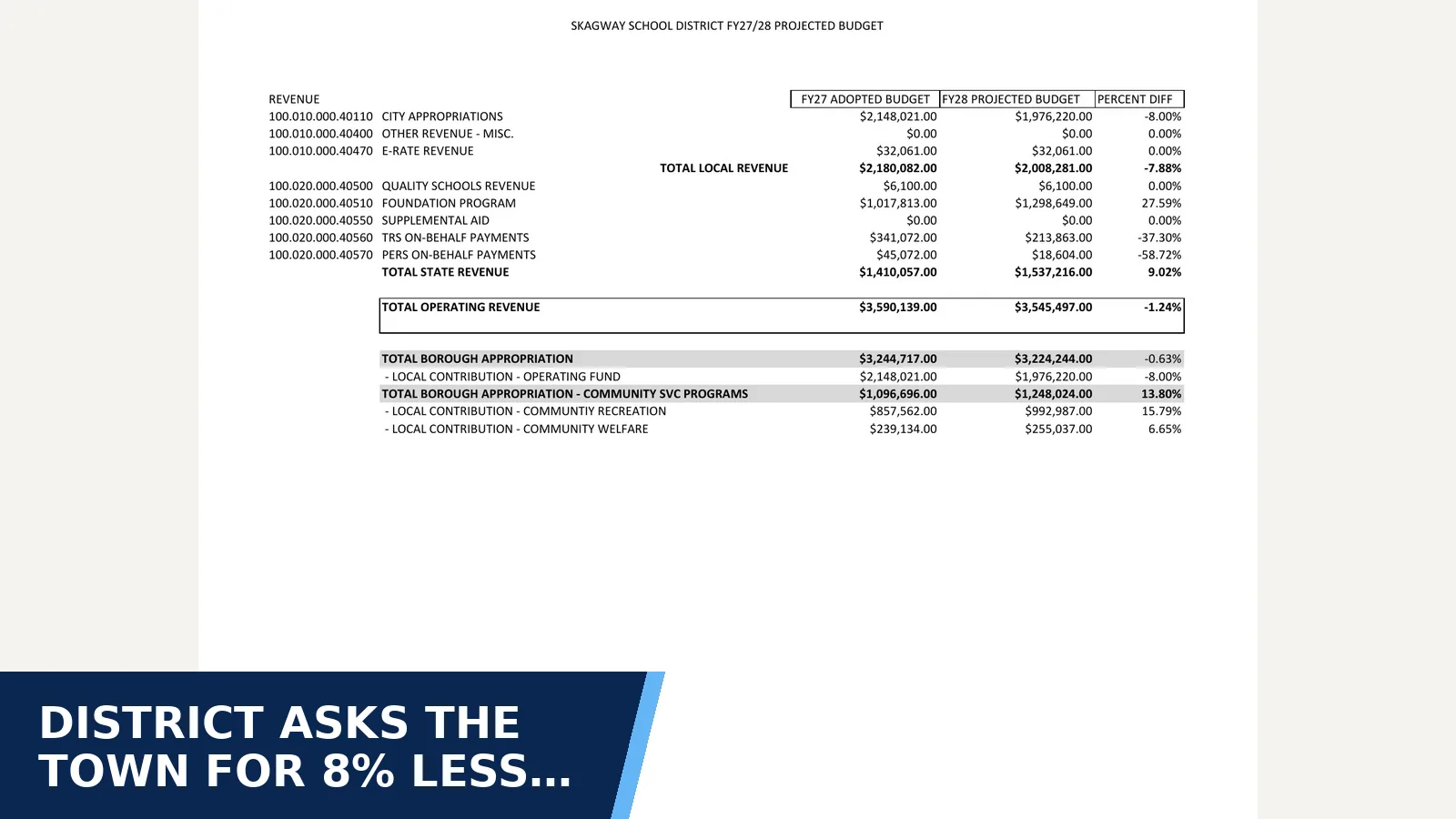
For 2027-28 the district plans to ask the Municipality of Skagway for $1,976,220 for school operations, down from $2,148,021. It expects state Foundation aid to rise from $1,017,813 to $1,298,649. Total operating revenue would dip 1.2%.
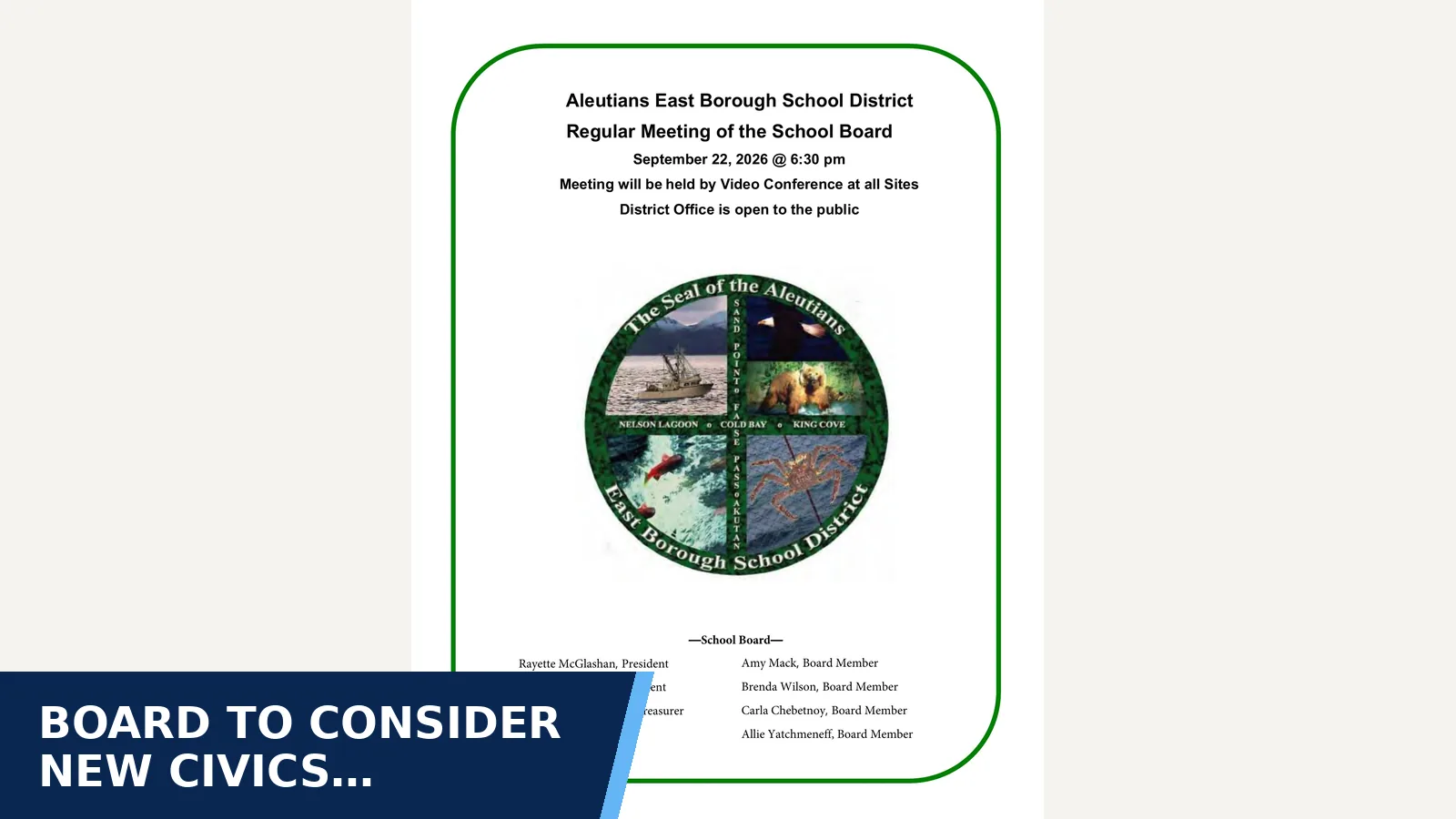
The board agenda listed an update to BP 6146.1, High School Graduation Requirements, for action; the packet does not establish whether it was approved. The superintendent’s report says students entering ninth grade after July 1, 2027 would need to complete and pass a state-developed civics curriculum and assessment to graduate, subject to specified exceptions.
At its September 21 special meeting, the Dillingham City School District board is scheduled to give a first read to a draft Work Experience Education policy and regulation. The proposal would allow students enrolled in an alternative program to earn elective credit through approved work-based learning, including summer work with advance approval.
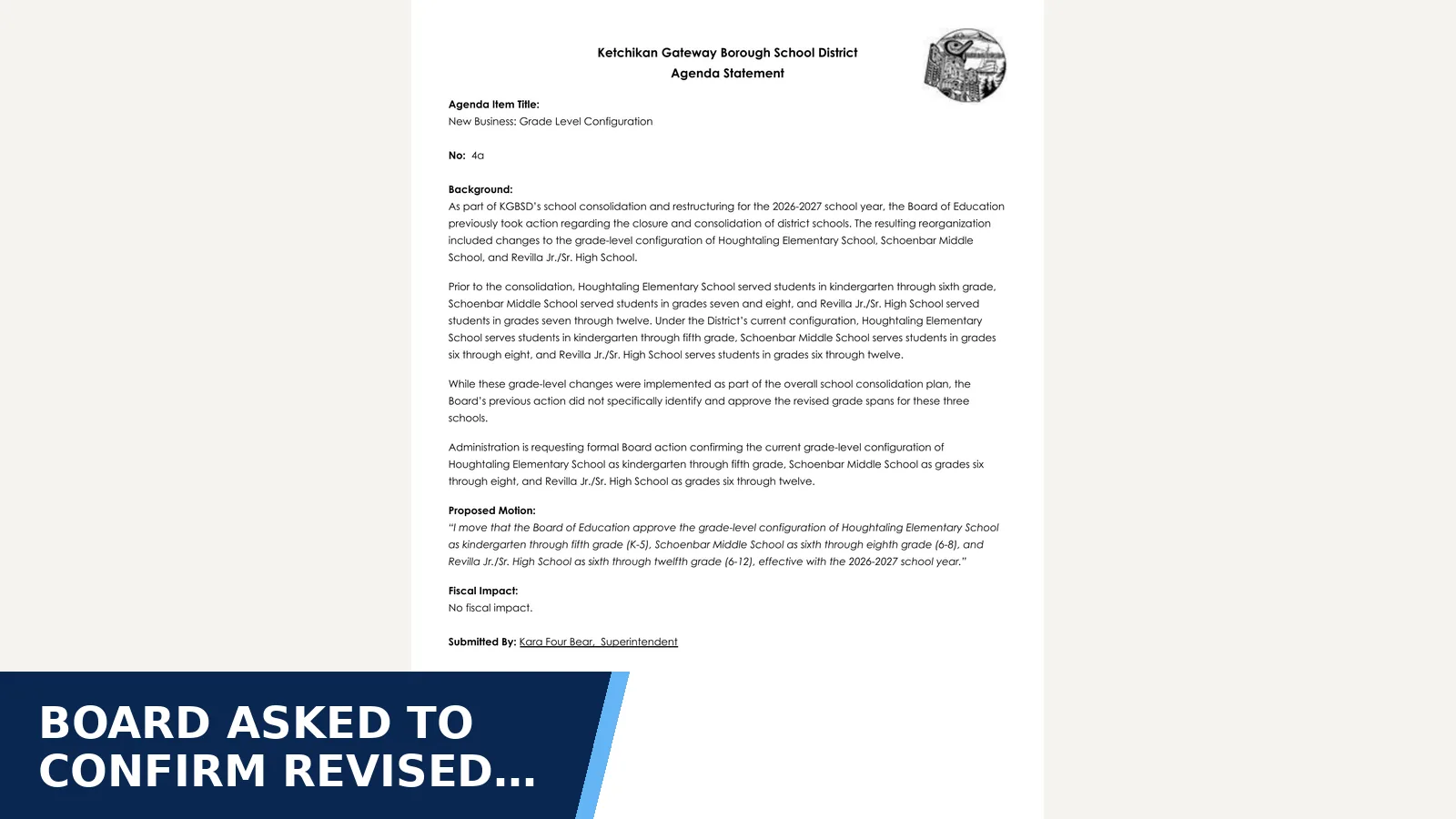
Administration is asking the board to formally confirm the grade spans already in effect for 2026–27: Houghtaling Elementary School K–5, Schoenbar Middle School 6–8 and Revilla Jr./Sr. High School 6–12. The agenda describes this as a proposed approval of the post-consolidation configuration, not a completed board action.