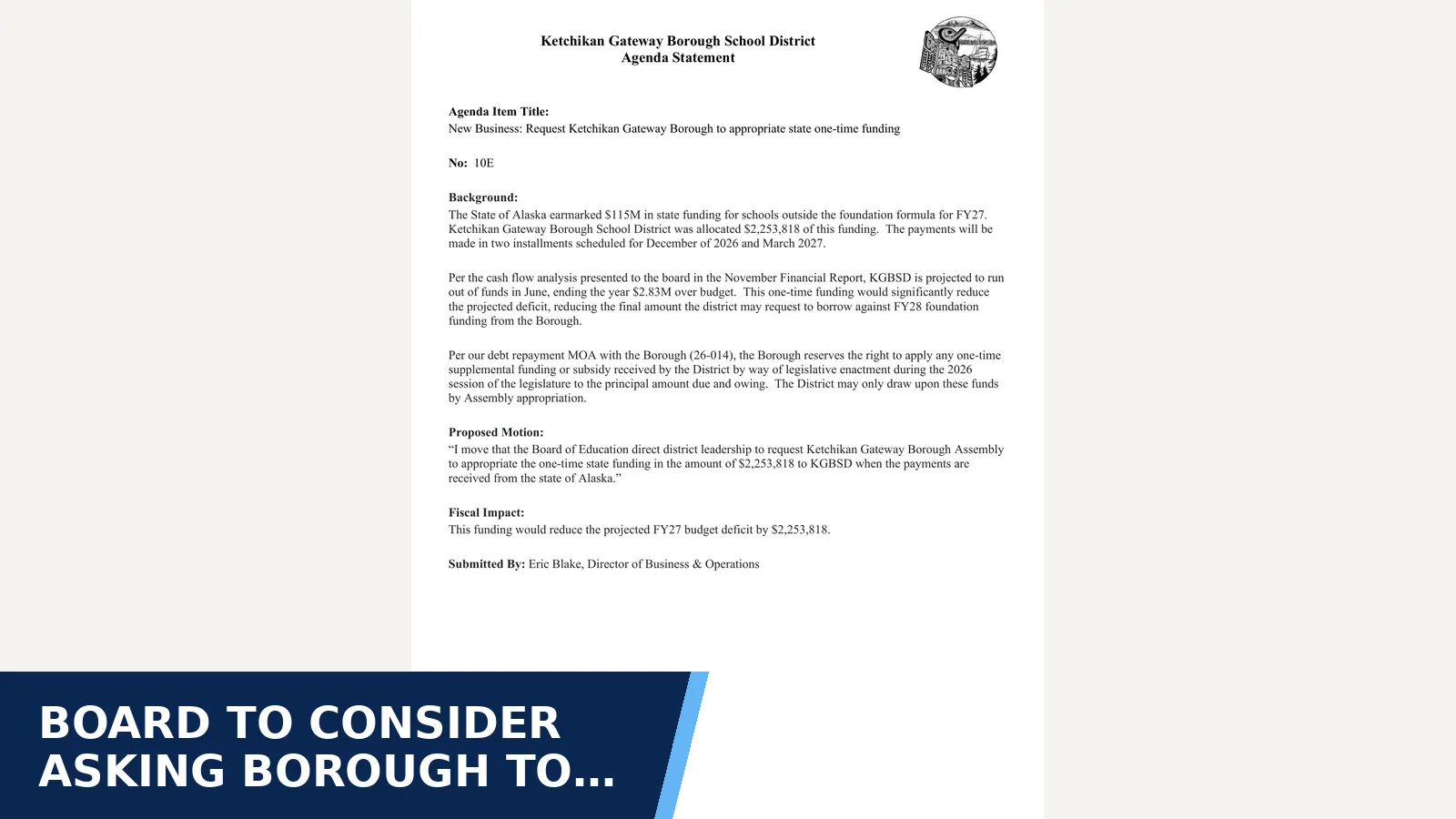
A proposed motion would direct district leaders to ask the Borough Assembly to appropriate $2,253,818 in one-time state aid to the district when the state sends the money.
We bring transparency to school decisions nationwide by tracking school board meetings, district documents, and public data. We use AI tools, rigorously evaluated for accuracy, to search for risks.
The policy desk
What’s moving in phones
The debate over phones, screens and the school day.
No recent stories in this edition. Explore the latest reporting below.
The policy desk
What’s moving in AI
How artificial intelligence is changing classrooms and school rules.
No recent stories in this edition. Explore the latest reporting below.
The policy desk
What’s moving in student voice
Students speaking up, organizing and helping shape their schools.
No recent stories in this edition. Explore the latest reporting below.
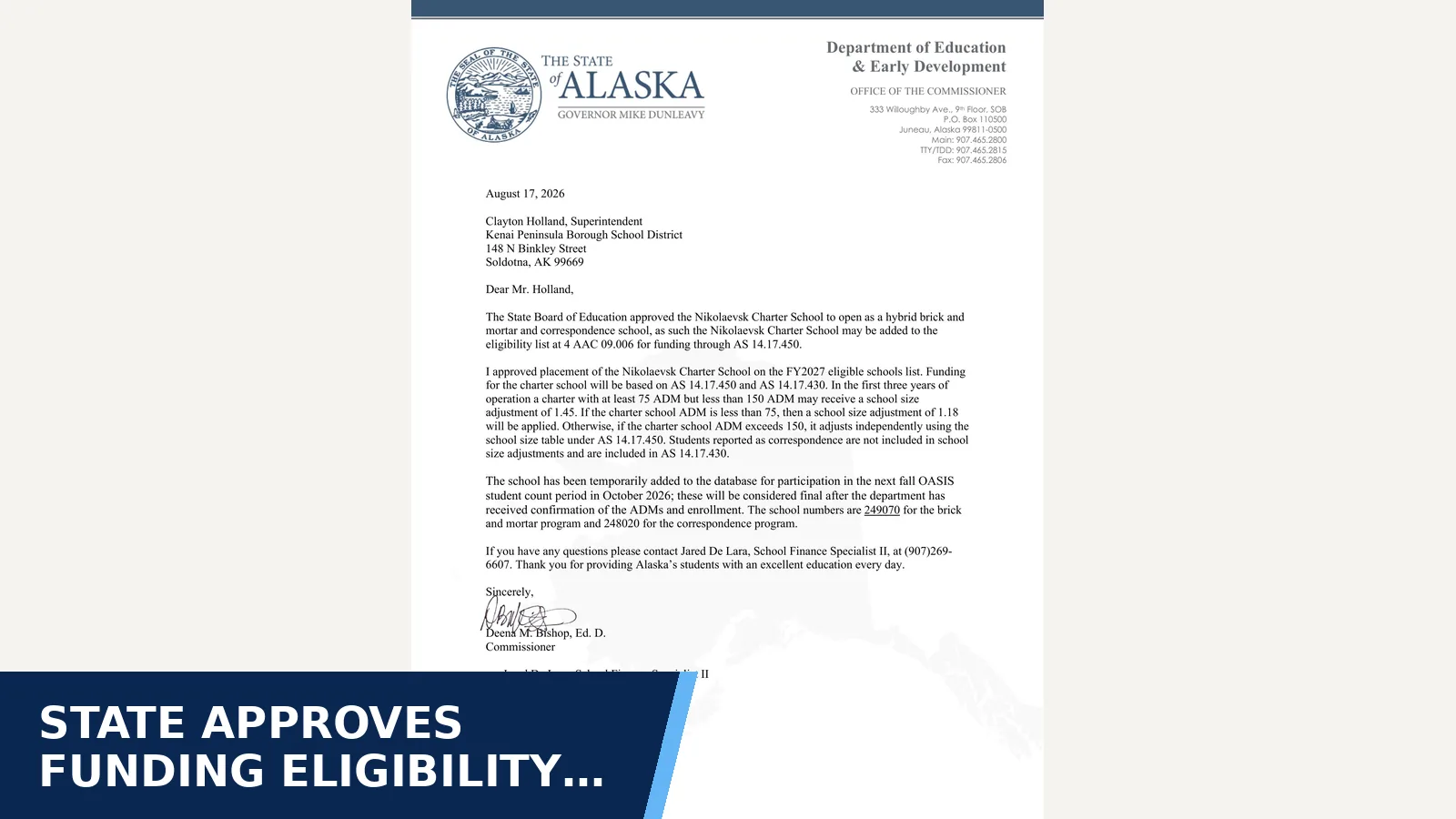
Alaska's Commissioner of Education approved placing Nikolaevsk Charter School on the FY2027 state funding-eligible schools list, formalizing state per-pupil funding (including a school-size adjustment) for both its brick-and-mortar and correspondence programs, pending confirmation of enrollment counts in the October 2026 count period.
As of September 4, 2026, K-12 enrollment stood at 3,678 students \u2014 89 students (2.36%) below the district's FY27 budget projection of 3,767 and 113 students (3.44%) below last year's actual enrollment. Kindergarten enrollment dropped sharply (down 51 students, -21%).
Administrators presented a non-action proposal (Memorandum #037) to the Board detailing how ASD would spend approximately $32.19 million in one-time HB 263 'waterfall' state funding: $14.58 million on 2026-27 investments (including restoring emergency reserves, charter school funding, student supports, snow removal/security, and student activities/transportation) and $17.6 million retained in fund balance to reduce the projected FY28 deficit from about $40 million to about $26.66 million.
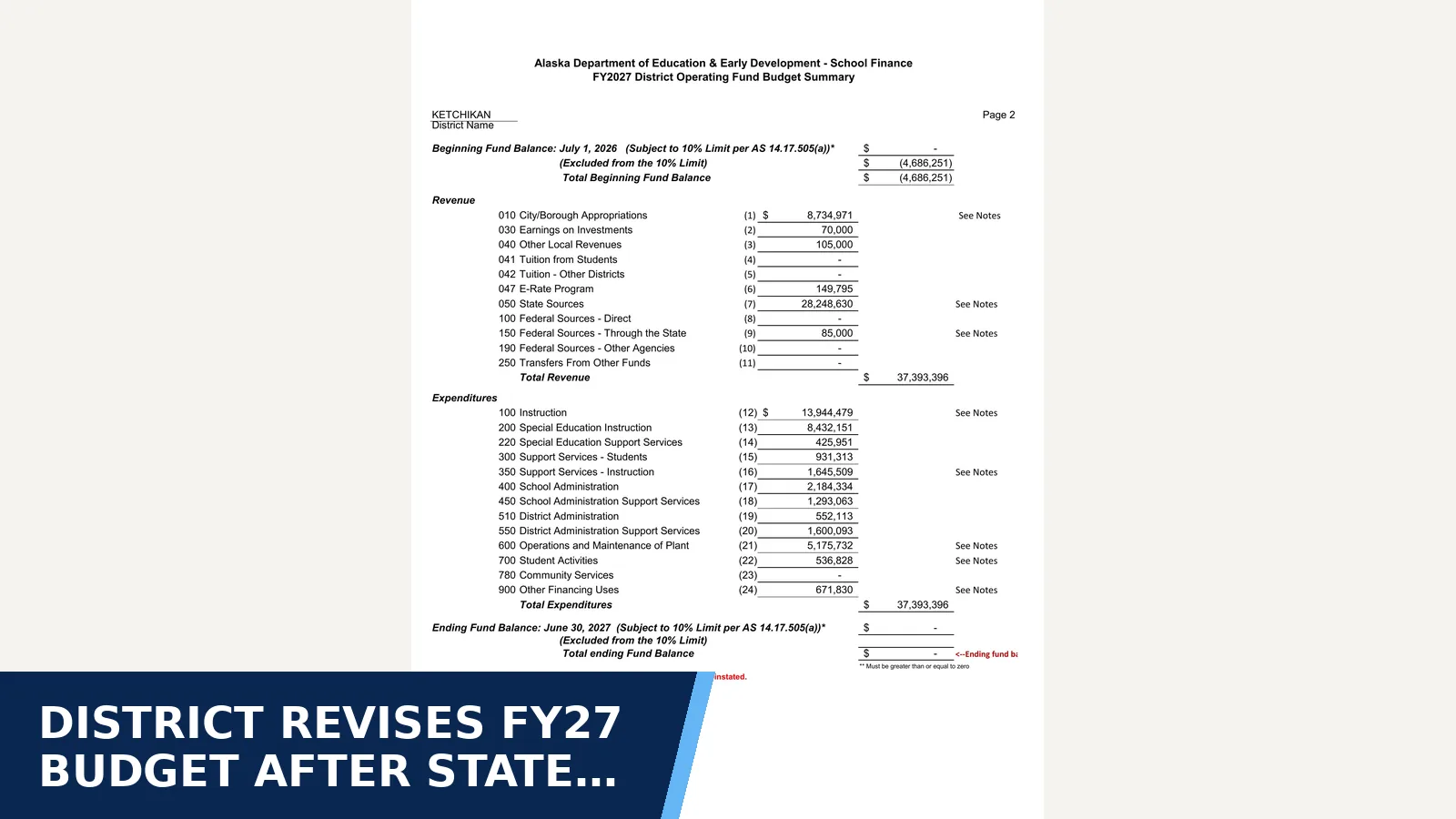
The Board approved DEED-mandated revisions to the FY2027 operating budget on August 26, 2026, after the state identified $366,651 in duplicated/disallowed in-kind revenue, missing Energy Relief Grant budgeting, and other errors; net revenue was corrected upward by roughly $109,250 (later refined to $448,504 in a follow-up document) with expenditure reallocations including funding for the new Houghtaling kindergarten position.
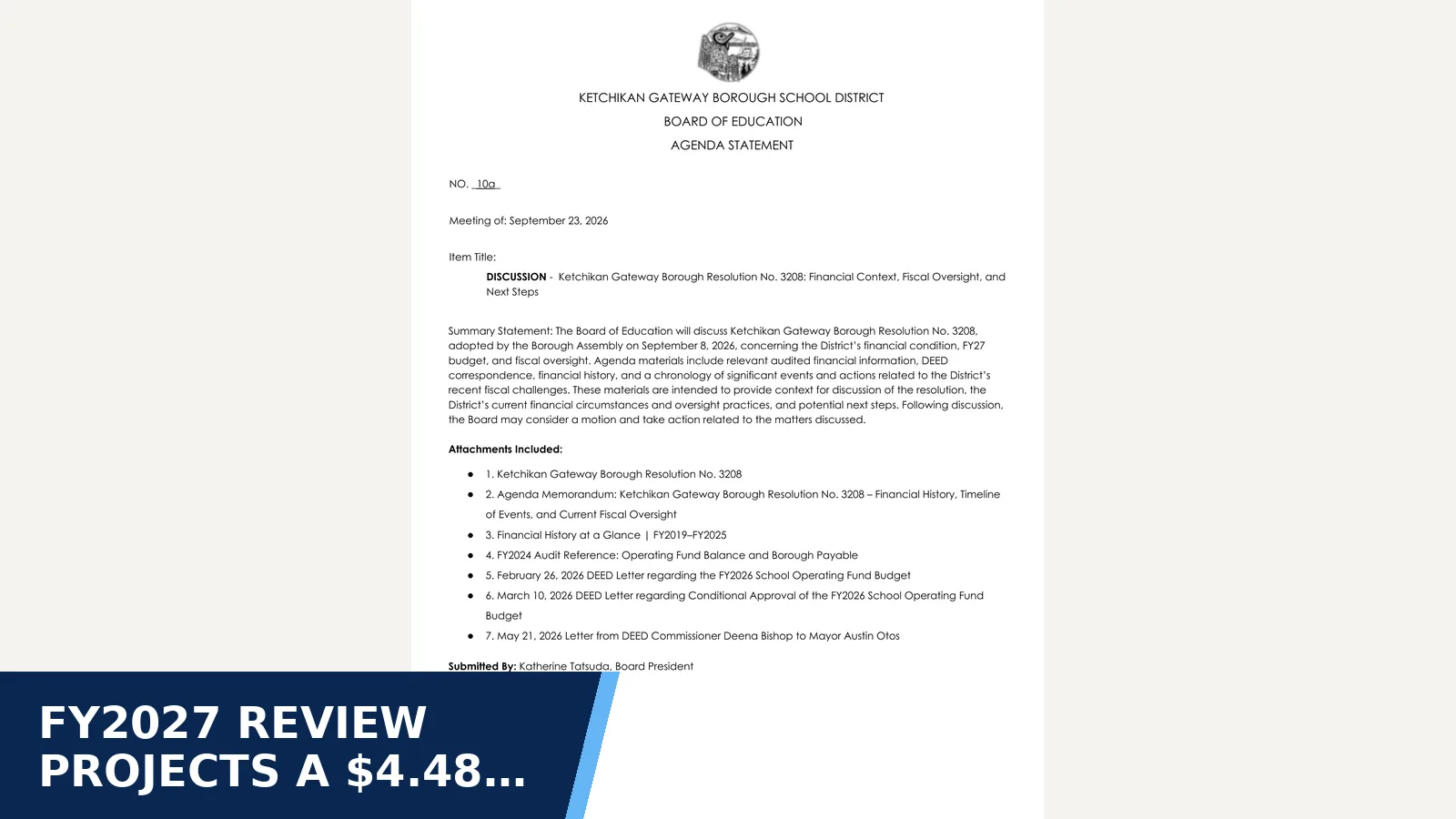
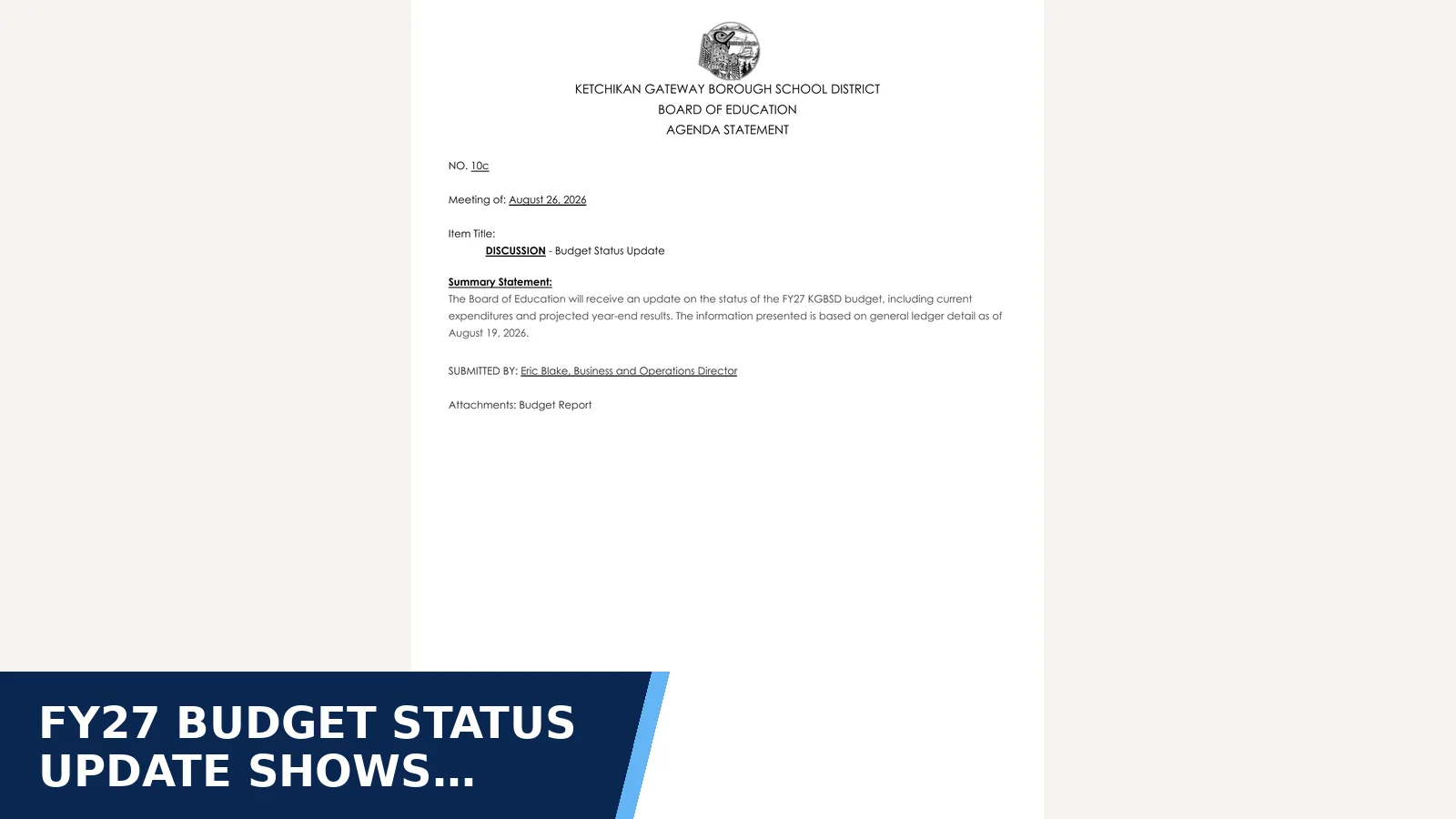
A Budget Status Update presented to the Board on August 26, 2026 projects the district will end FY2027 with a shortfall of approximately $4,481,576, driven by unbudgeted encumbered expenditures (about $4.28M) and over-budget spending (about $2.5M) across special education, health insurance, and staffing lines, plus unresolved risk areas including pupil transportation and food service funds with no developed budget.
The district's Health Insurance Task Force presented comparative proposals from USI (current broker, self-funded at $6,957,700), HUB International (self-funded $7,219,377 / fully funded $7,707,344), and the Public Educator Health Trust (fully funded $5,813,265) at the August 26, 2026 board meeting, continuing evaluation of a change to the district's employee health coverage model.
Following adoption of the FY27 budget, the Alaska Legislature's HB263 and other sources are expected to bring AEBSD approximately $353,222 in one-time supplemental (Foundation Waterfall) funds and $205,571 in energy-relief funding, plus the Borough increased its local contribution by $100,000 to $1.4 million. Superintendent recommends using much of this one-time money for strategic, non-recurring investments (vans, weight rooms, building improvements, safety/security) rather than new recurring costs.
Facing a separate, $4.6 million year-end cash shortfall for FY2026, the district asked the Borough for emergency help. The Borough Assembly authorized up to $5 million in supplemental funding in May 2026; the district ended up drawing $3 million of it to close out the year. That $3 million is now being deducted from the district's FY2027 local funding in quarterly installments, on top of the separate $5.4 million debt-repayment plan.
On June 17, 2026, the board adopted the FY2027 Operating Fund Budget: $57,525,643 in projected revenue against $65,722,155 in planned spending, with the roughly $8.2 million gap covered by drawing down the district's existing fund balance (savings) rather than by new revenue.
MSBSD's adopted FY2026 budget already cut school discretionary budgets 15%, department budgets 18%, the transportation subsidy 13%, and eliminated 159 positions. In December 2025 the district told the board that enrollment has been declining since 2024 and is expected to keep falling, and a March 2026 budget work session was titled "Proposed Reductions." The board adopted the FY2027 budget on June 3, 2026. By August 2026, opening enrollment stood at roughly 14,508 students headed toward an expected 18,737 -- down from about 19,700 enrolled districtwide a few years earlier.
On June 2, 2026 the board approved the 2026-27 budget. It removes one elementary teaching job, so some grades will be combined. It does not refill the librarian and distance-education job, and it skips the Close Up trip for one year to save $40,000.