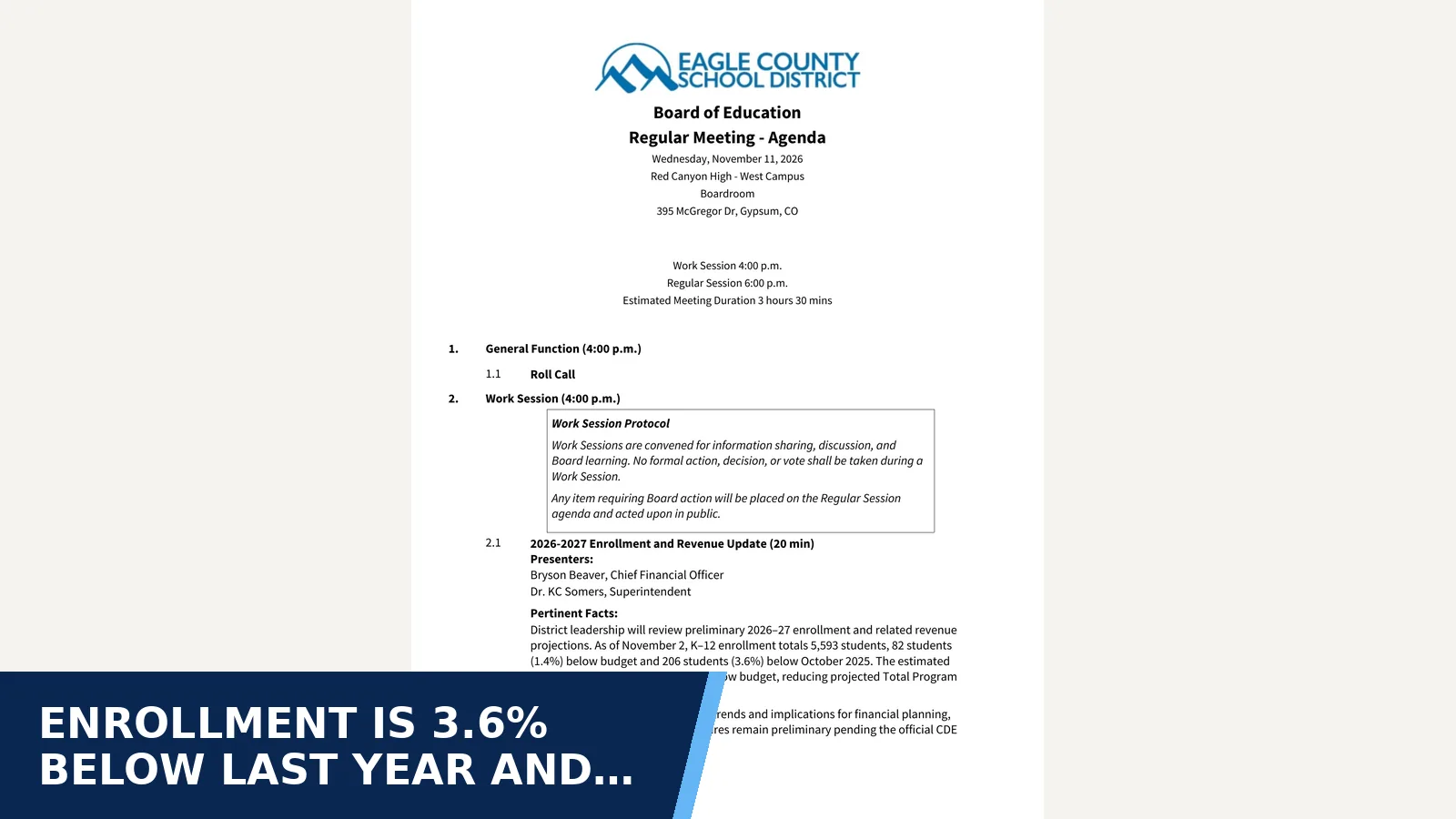
The November 11, 2026 agenda reports K-12 enrollment of 5,593 students as of November 2, which is 82 (1.4%) below budget and 206 (3.6%) below October 2025.
We bring transparency to school decisions nationwide by tracking school board meetings, district documents, and public data. We use AI tools, rigorously evaluated for accuracy, to search for risks.
The policy desk
What’s moving in phones
The debate over phones, screens and the school day.
No recent stories in this edition. Explore the latest reporting below.
The policy desk
What’s moving in AI
How artificial intelligence is changing classrooms and school rules.
No recent stories in this edition. Explore the latest reporting below.
The policy desk
What’s moving in student voice
Students speaking up, organizing and helping shape their schools.
No recent stories in this edition. Explore the latest reporting below.
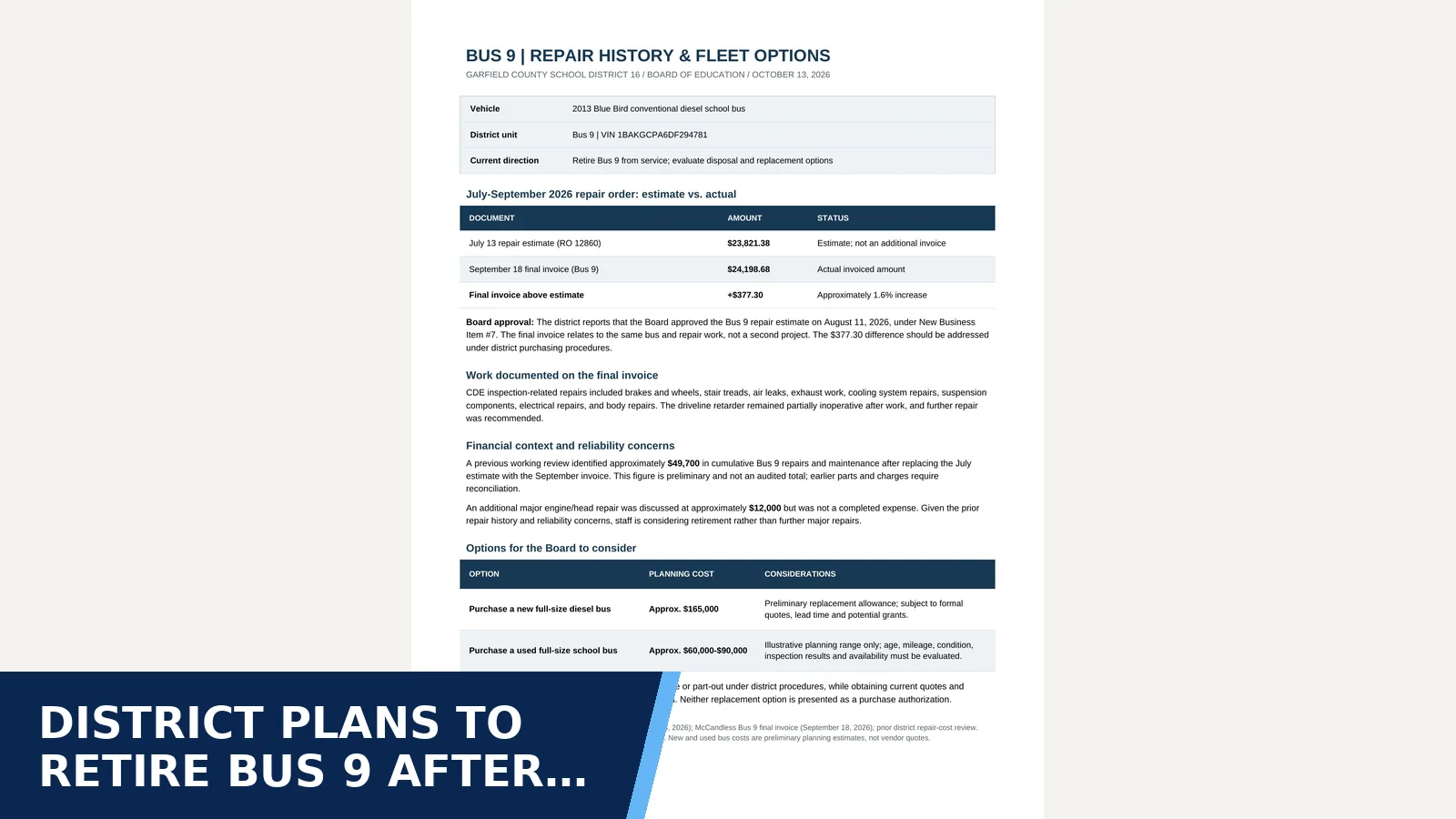
Staff told the board it plans to retire Bus 9, a 2013 diesel bus, after about $49,700 in repairs, including a repair of about $24,200 that the board approved in August at $23,821. A new bus would cost about $165,000 and a used one about $60,000 to $90,000. No purchase was proposed.
Revised purchasing policies (DJB and DJB-R) raise the limit for small purchases without quotes from $10,000 to $15,000 and the level that triggers formal bidding from $250,000 to $350,000.
On October 12, 2026 the business manager reported the district is being paid for 209 students per the state's projection but its funded enrollment is 193; state payments will be trued up starting in January. With averaging the district will be funded for about 201 students, about $4.119 million in total program funding, roughly $20,422 per pupil. In September she reported the preliminary assessed value fell to $71.1 million from $72.1 million.
On October 7, 2026 the board was to hear from the district's financial adviser and choose a refunding option for its school bonds. The superintendent recommends approving a refunding when interest rates would save at least 3%. A bond report had also been on the March and April agendas.
On October 6, 2026 the board voted 5-0 to add one mill to the Debt Free Schools mill, for a total of 7.819 mills in fiscal year 2027. A mill is a property-tax rate of $1 for every $1,000 of assessed value. The same meeting included a CFO presentation on the increase and a mailer showing the tax impact to homeowners.
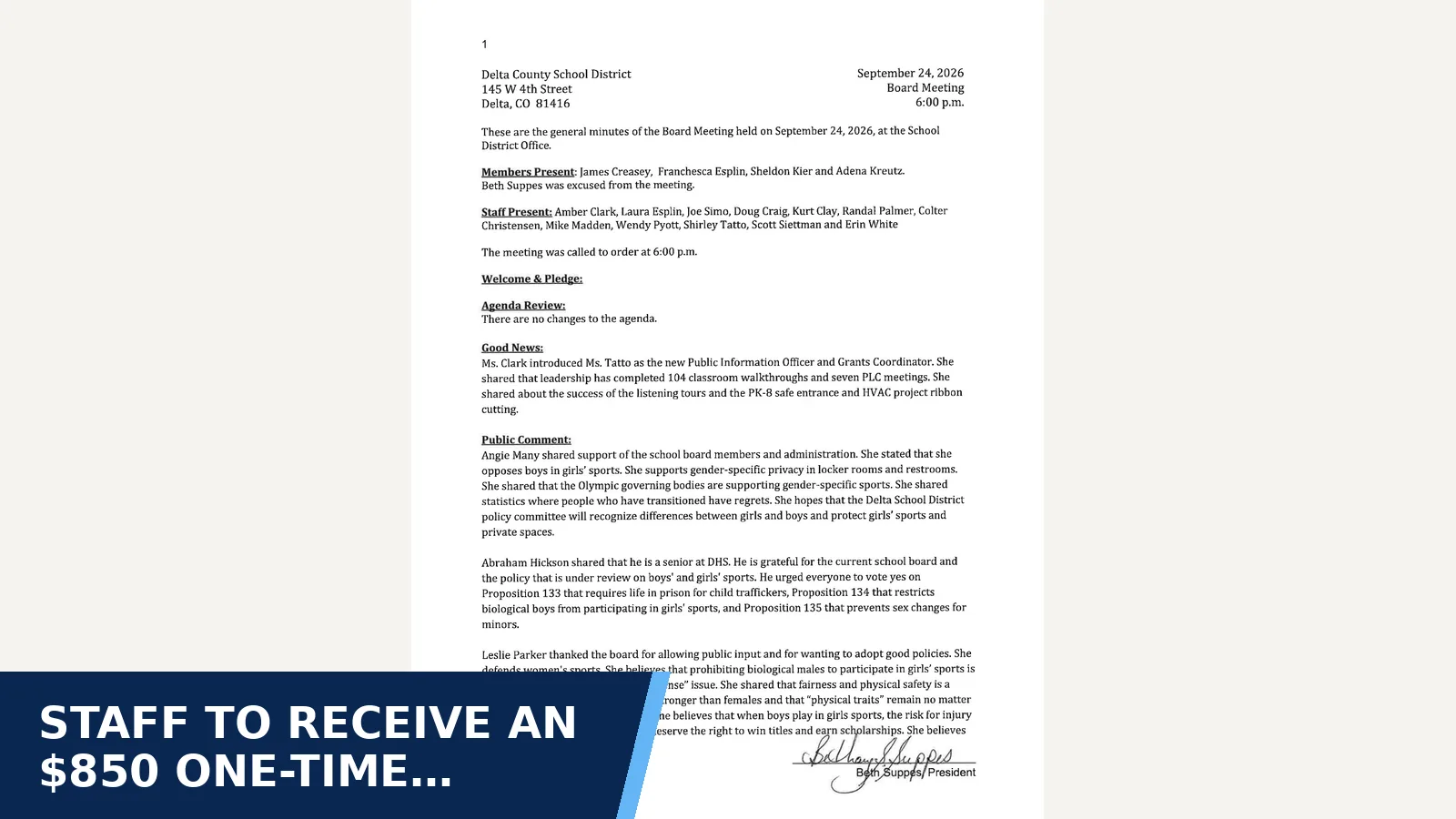
On September 24, 2026 the board approved a one-time $850 payment to all contracted staff, to be paid in October or November from the district's interest income reserve. The board also approved a Technical College of the Rockies salary schedule with a base of $43,200, up $288, and moved 2027 graduation ceremonies one week earlier in May.
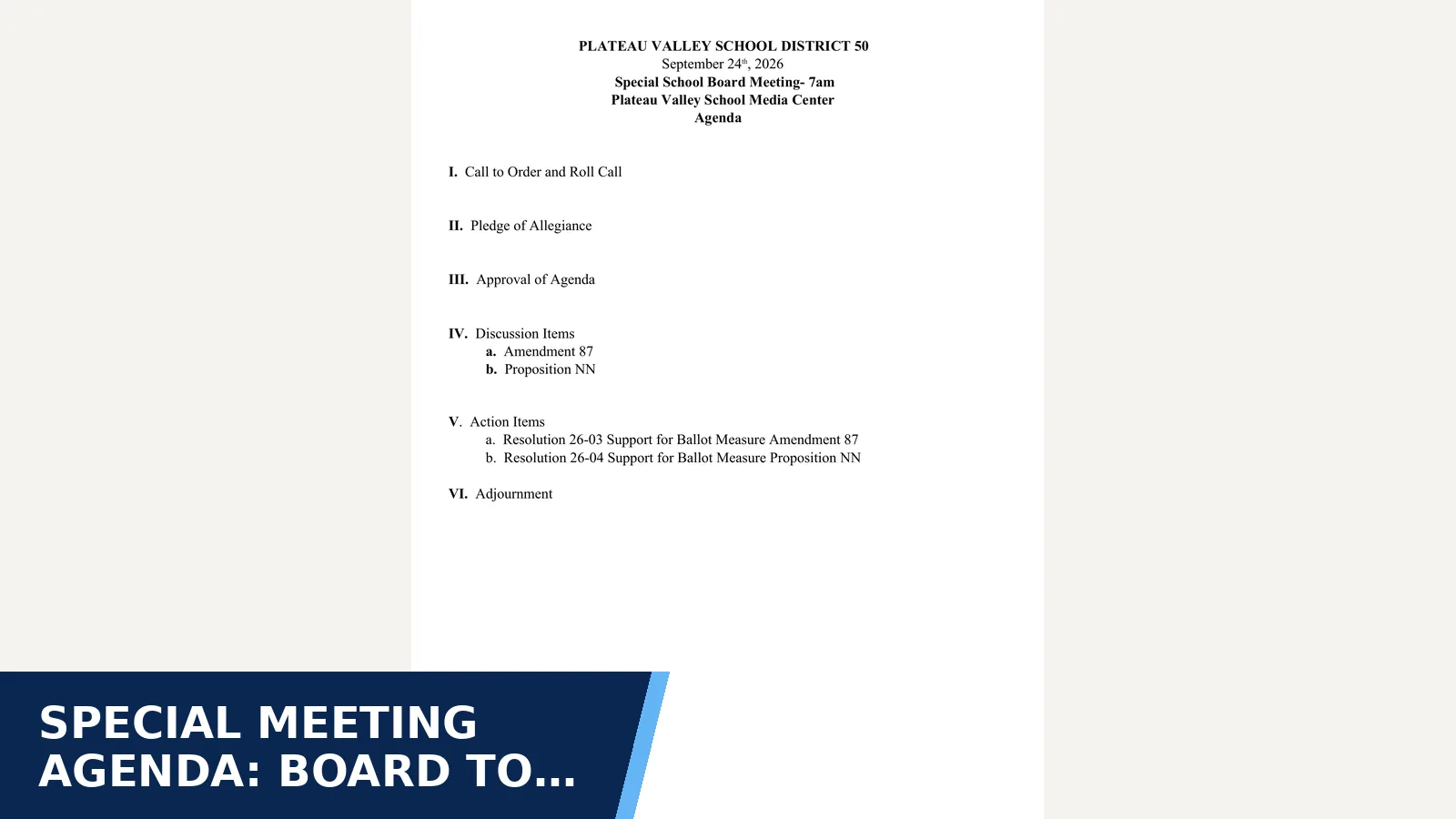
A special board meeting on September 24, 2026 at 7 a.m. listed discussion of Amendment 87 and Proposition NN and action on Resolution 26-03 (support for Amendment 87) and Resolution 26-04 (support for Proposition NN). In August the superintendent had briefed the board on a statewide income tax proposal that would fund schools and on Proposition NN, a legislatively referred measure about state revenue and school funding. Both were statewide ballot items for November 2026. The collected records show the agenda, not the votes.
On Sept 24, 2026 the board unanimously adopted a plan for the 2024 voter-approved mill levy override ($9 million a year). Every school gets its full share first, then each school, including charters, is charged for D2 Promise college scholarships used by its own graduates.
On Sept 24, 2026 the board voted 5-0 to refuse to use district property tax money for a senior housing project at Sugarbowl Point. The developer, The Szanton Company, had asked for tax increment financing (TIF), which would send the tax growth from the new buildings to the project instead of to schools.
The district's required financial notice shows the general fund balance dropped from $10,551,757 (2022-23) to $5,887,340 (2024-25) to a projected $1,960,647 for 2025-26 and 2026-27. In 2025-26 the district spent about $32.4 million against revenue of about $28.5 million. It borrowed $7.5 million for cash flow in 2025-26 and expects to borrow $7 million in 2026-27.
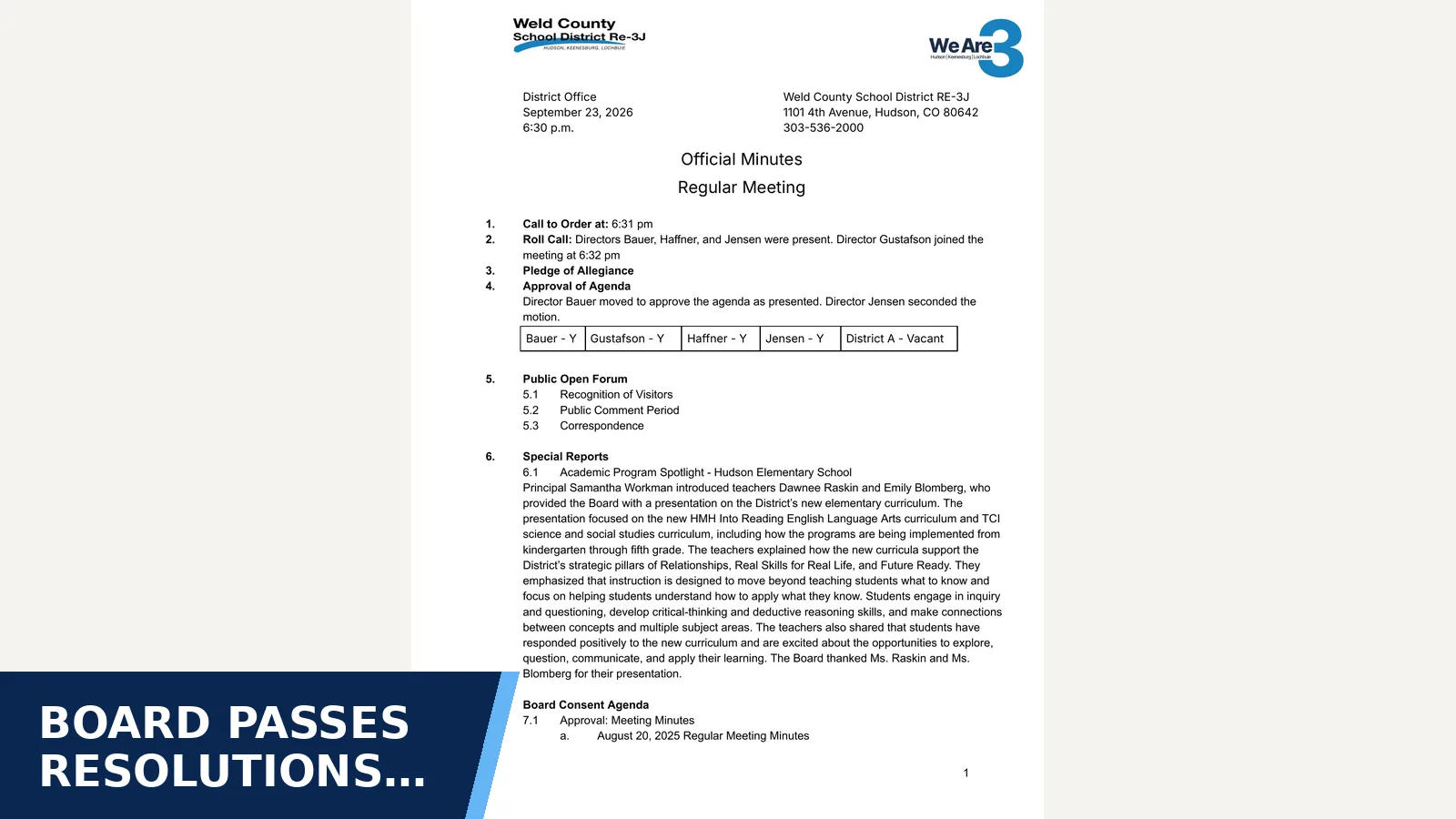
On September 23, 2026 the board approved Resolution #3-2027 supporting Amendment 87 (formerly Initiative 195), which would replace Colorado's flat income tax with graduated rates and send new revenue to child care, health care and education, and Resolution #4-2027 supporting Proposition NN, which would let the state keep revenue otherwise refunded under TABOR and direct at least a 2 percent yearly increase in K-12 funding for ten years. The superintendent estimated Amendment 87 could bring the district about $2 million and noted a board may not campaign but may adopt a resolution of support. Both measures were on the November 3, 2026 ballot; results are not in the collected records.
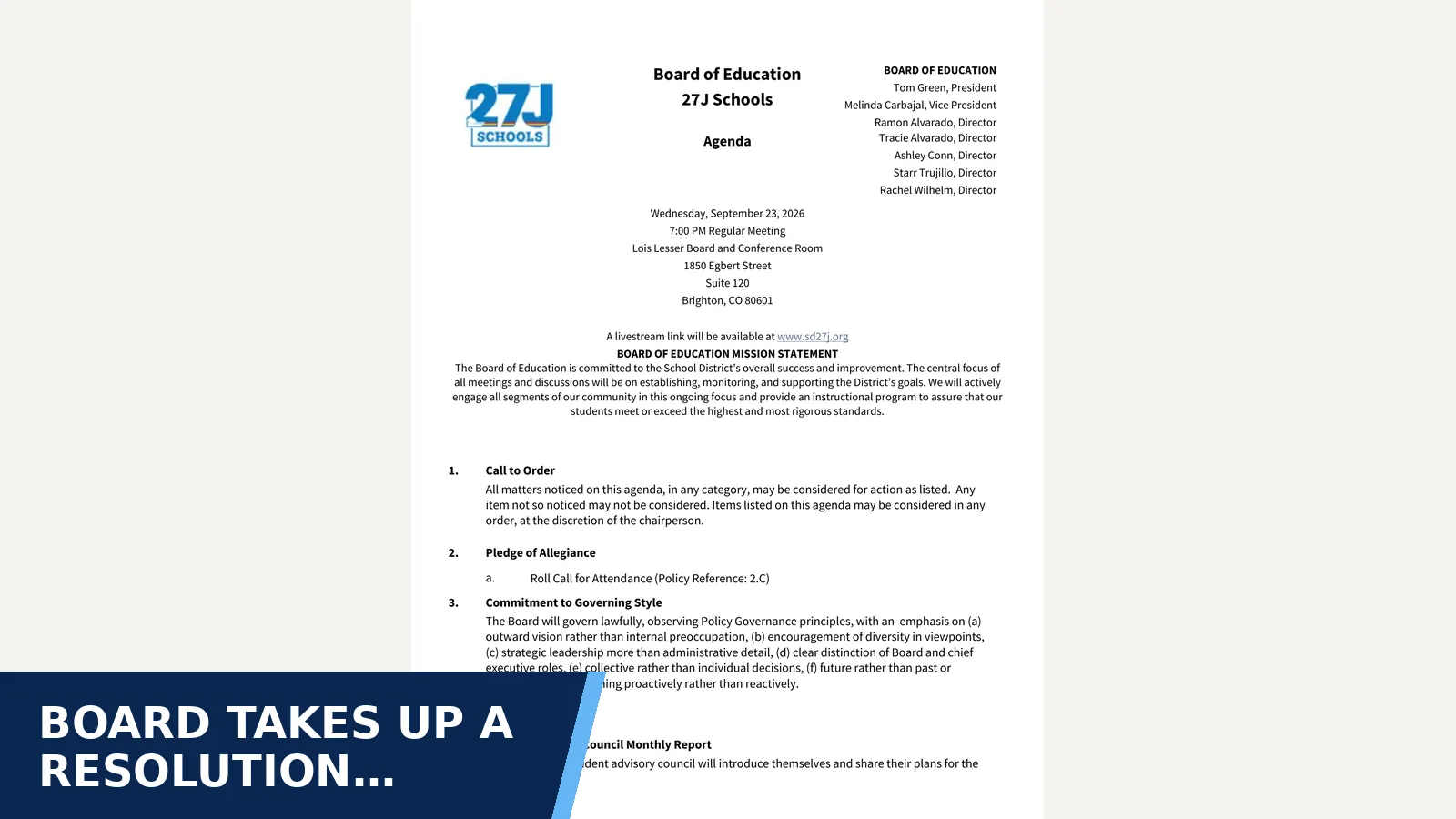
The Sept. 23 agenda lists a resolution supporting Proposition NN, which would increase K-12 funding and educator pay. In the meeting recording, board members discussed whether it could make a future local mill levy override harder to win.
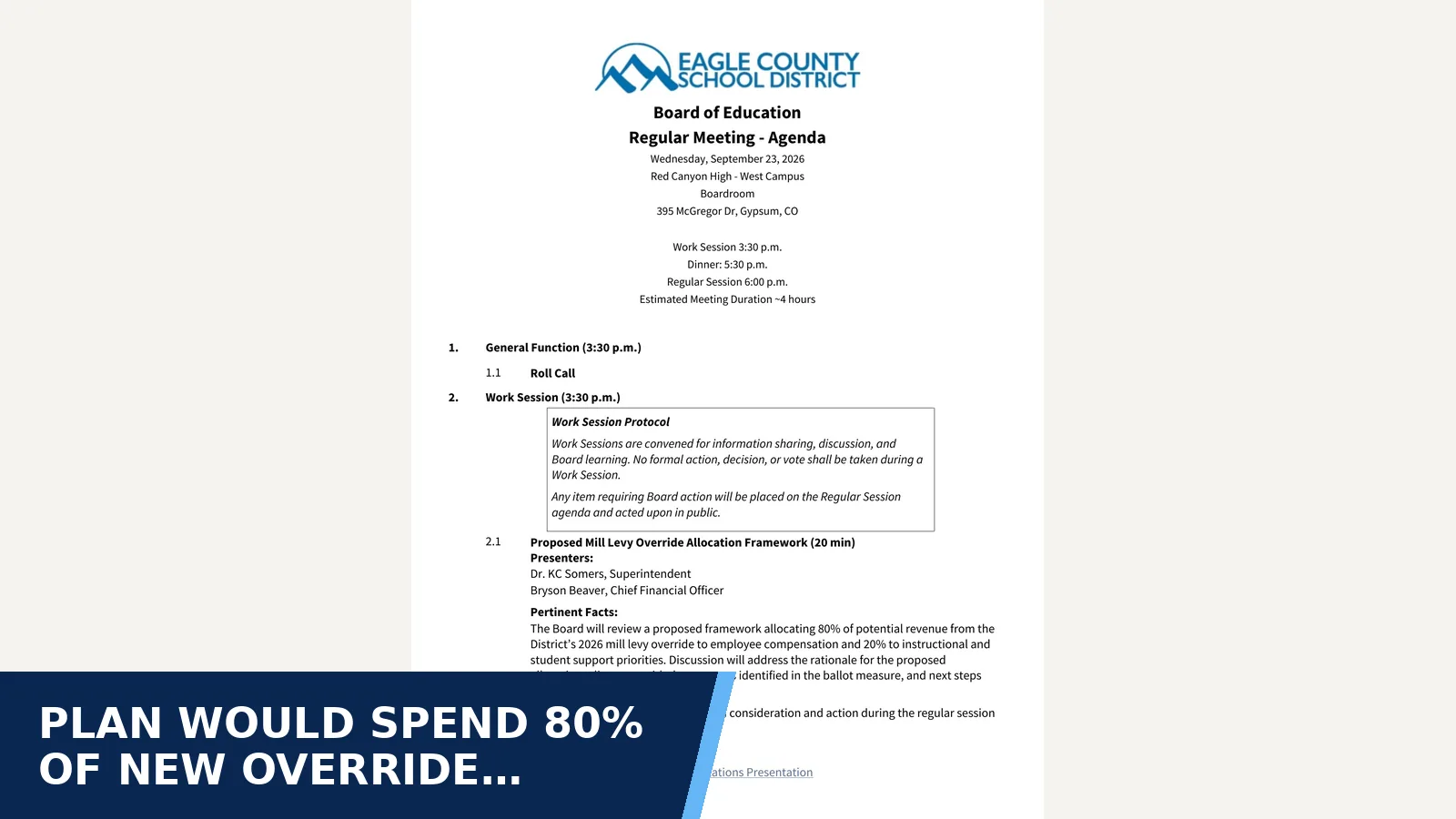
The September 23, 2026 agenda proposed that 80% of the mill levy override revenue go to employee compensation and 20% to instruction and student support, following talks with the Eagle County Education Association. It was set for a board vote that evening.
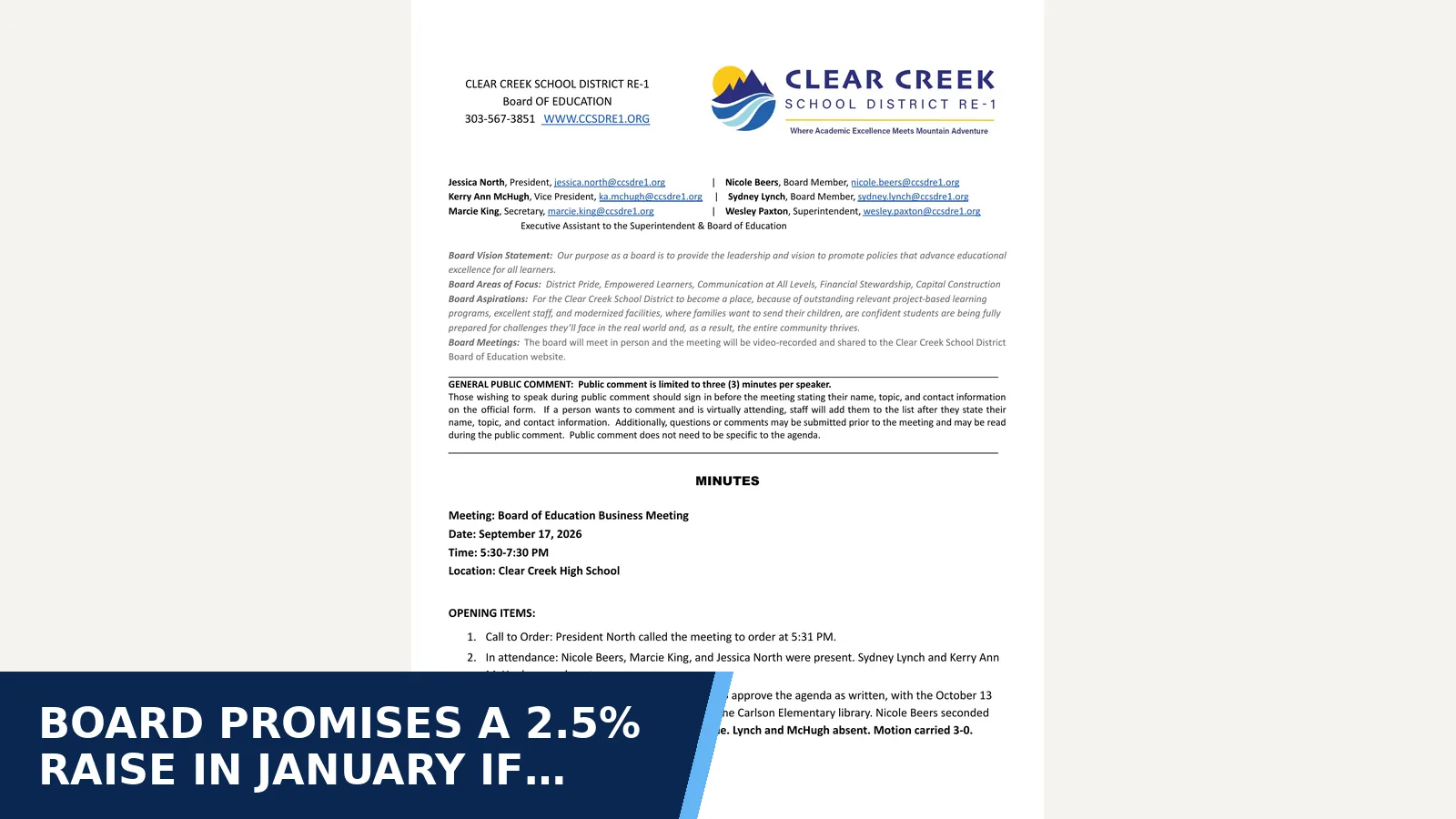
The board voted 3-0 on September 17, 2026 to give eligible teachers and staff one salary step, about 2.5%, on January 1, 2027, but only if voters approve the November 3 debt-free schools measure. A second resolution says the board will review the levy each year and collect less than the voters authorized when the full amount is not needed.
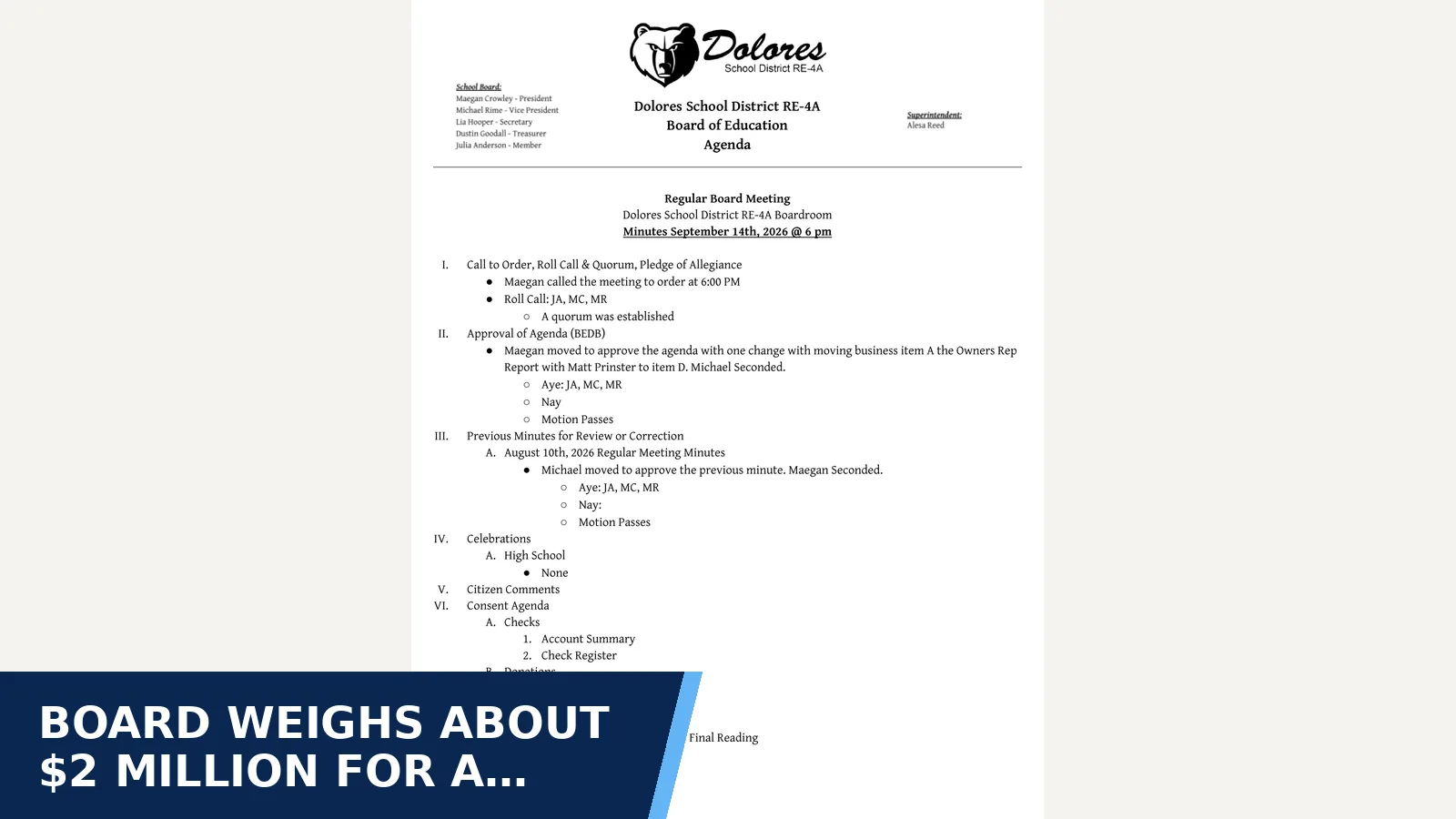
The board has been studying a track and field. In June the owner's representative put the all-in cost of materials and work at over $4.3 million, with the track alone about $800,000 to $1 million. On September 14, 2026 the board heard that $1 million is set aside in the budget and about $972,000 could be moved from contingency, for roughly $1.97 million. Itemized bids were due in late September, and the October 12 agenda lists a proposal to allocate contingency reserve funds for the track and field.
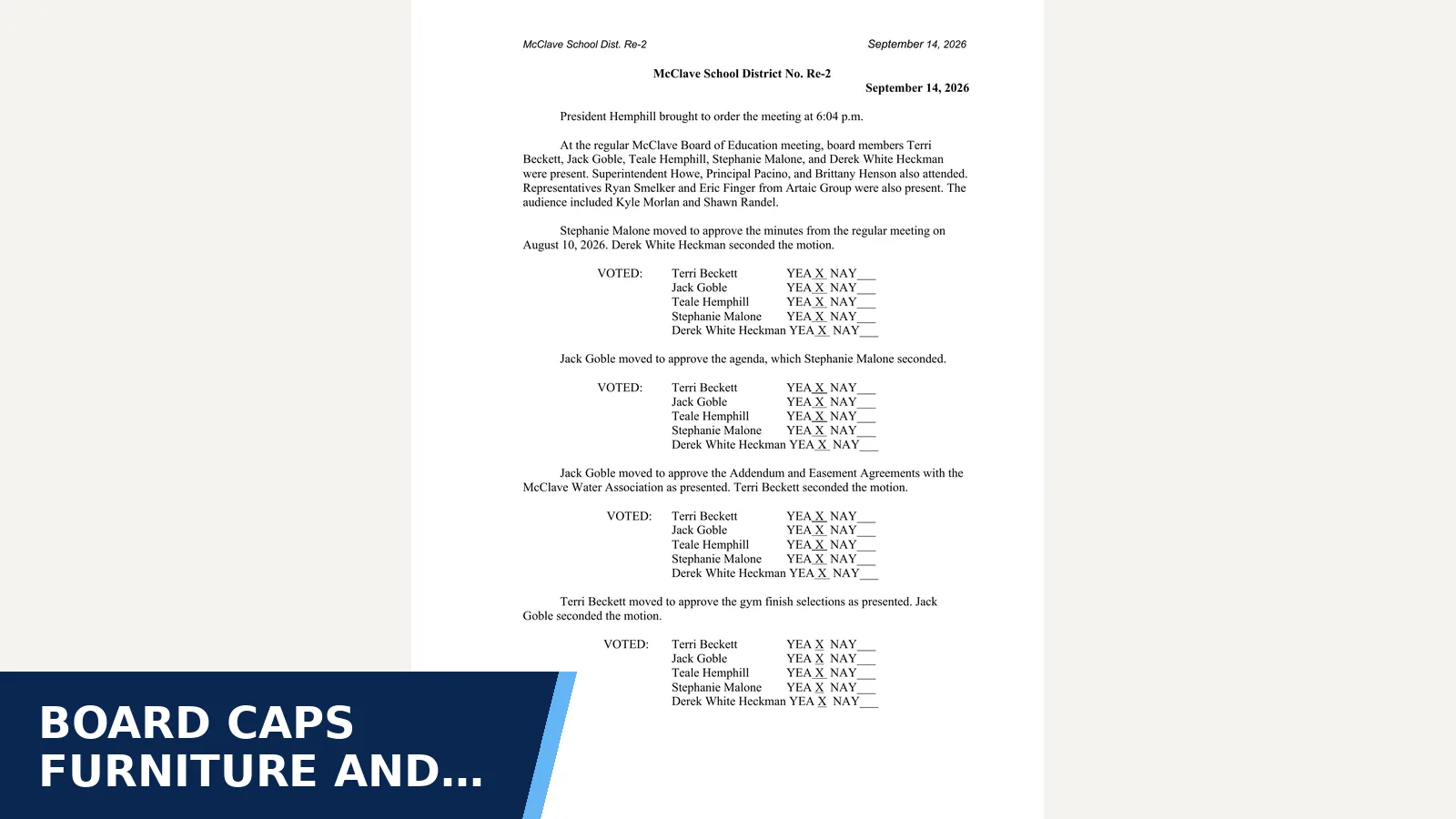
On Sept 14, 2026 the board approved a budget of up to $700,000 for furniture, fixtures and equipment for the new school, with OS Schools. It also picked gym finishes and a design change to the concession stand.
On Aug. 26 the board voted 5-0 to approve a Mill Levy Override resolution for the Nov. 3, 2026 ballot to raise teacher pay and help keep teachers. News reports say the override was for up to $5.6 million and that voters approved it on Nov. 3.
On August 26, 2026 the board considered a resolution placing a $10.1 million mill levy override on the November 3 ballot, starting in 2027 tax collection. The ballot language lists keeping and attracting teachers and staff with competitive pay, stronger reading, writing and math, restoring art, music and PE, and keeping mental health staff. Chalkbeat reported on November 5 that Eagle County's measure passed; the November 11 agenda says results are reported and certification is pending.
On Aug. 26 the board voted 5-0 to put a question on the Nov. 3, 2026 ballot. It would let the district collect the full amount of property tax voters approved in 1988, 2002 and 2018, up to a new state limit of 27%. The district currently operates at the old 25% limit. It estimates about $2 million more a year, with no new tax.
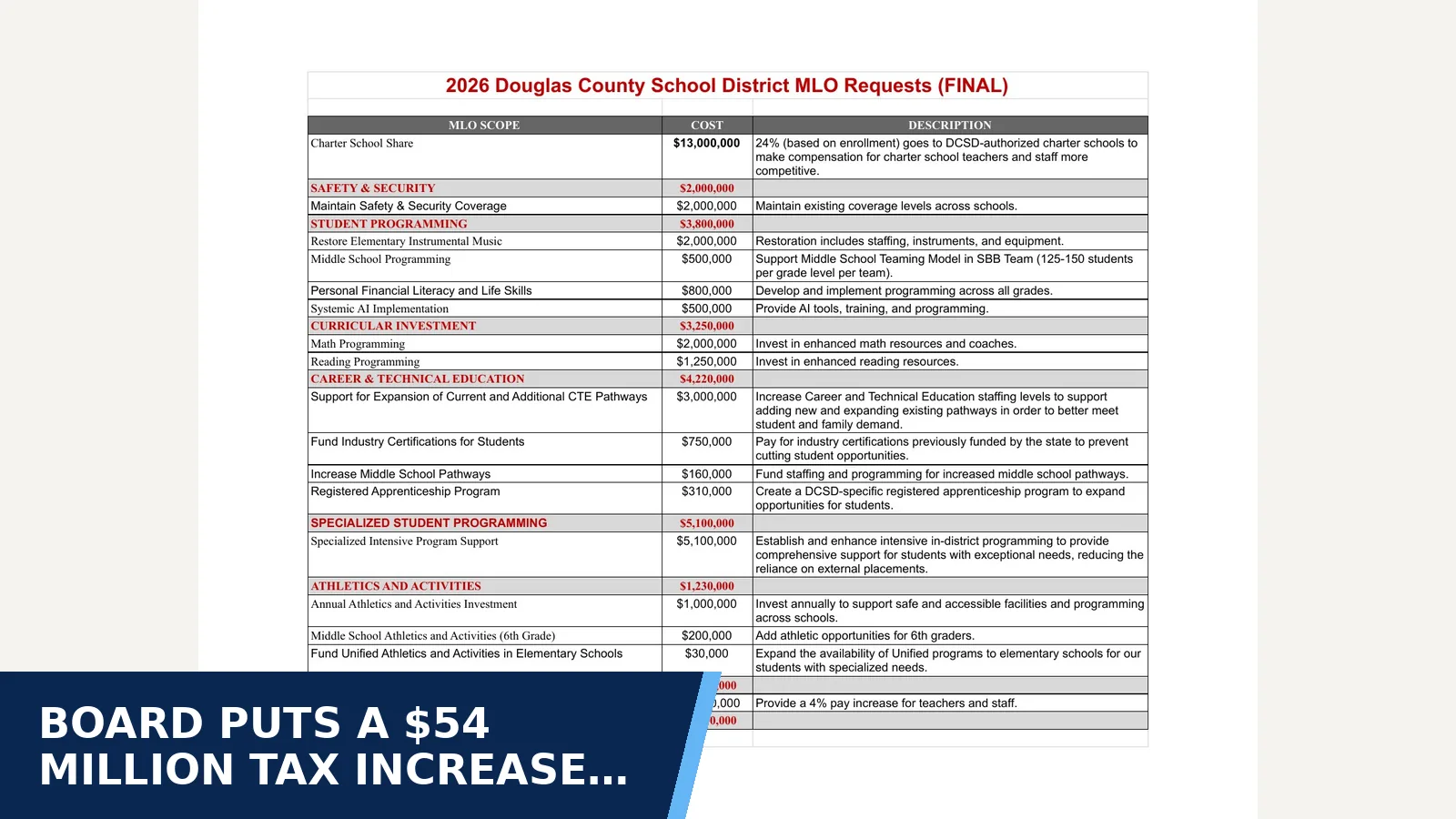
On Aug. 25, 2026 the board took up a resolution asking voters to raise district taxes by $54 million a year, starting in 2027, to pay for operating costs.
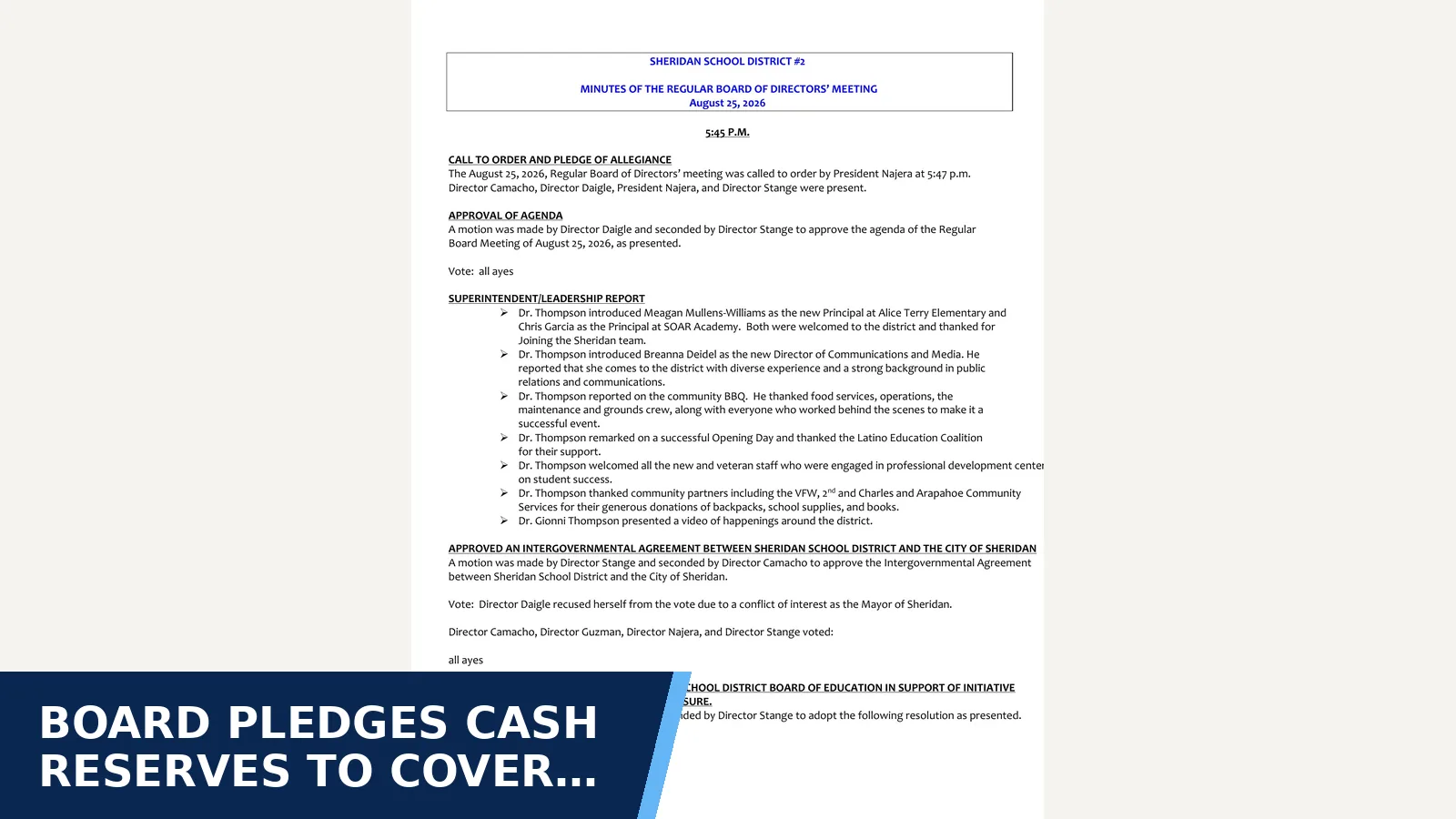
On August 25 the board irrevocably pledged cash reserves to cover the district's maximum obligations under multi-year personnel agreements, including salary, benefits and severance. The chief financial officer must recalculate the amount every year.