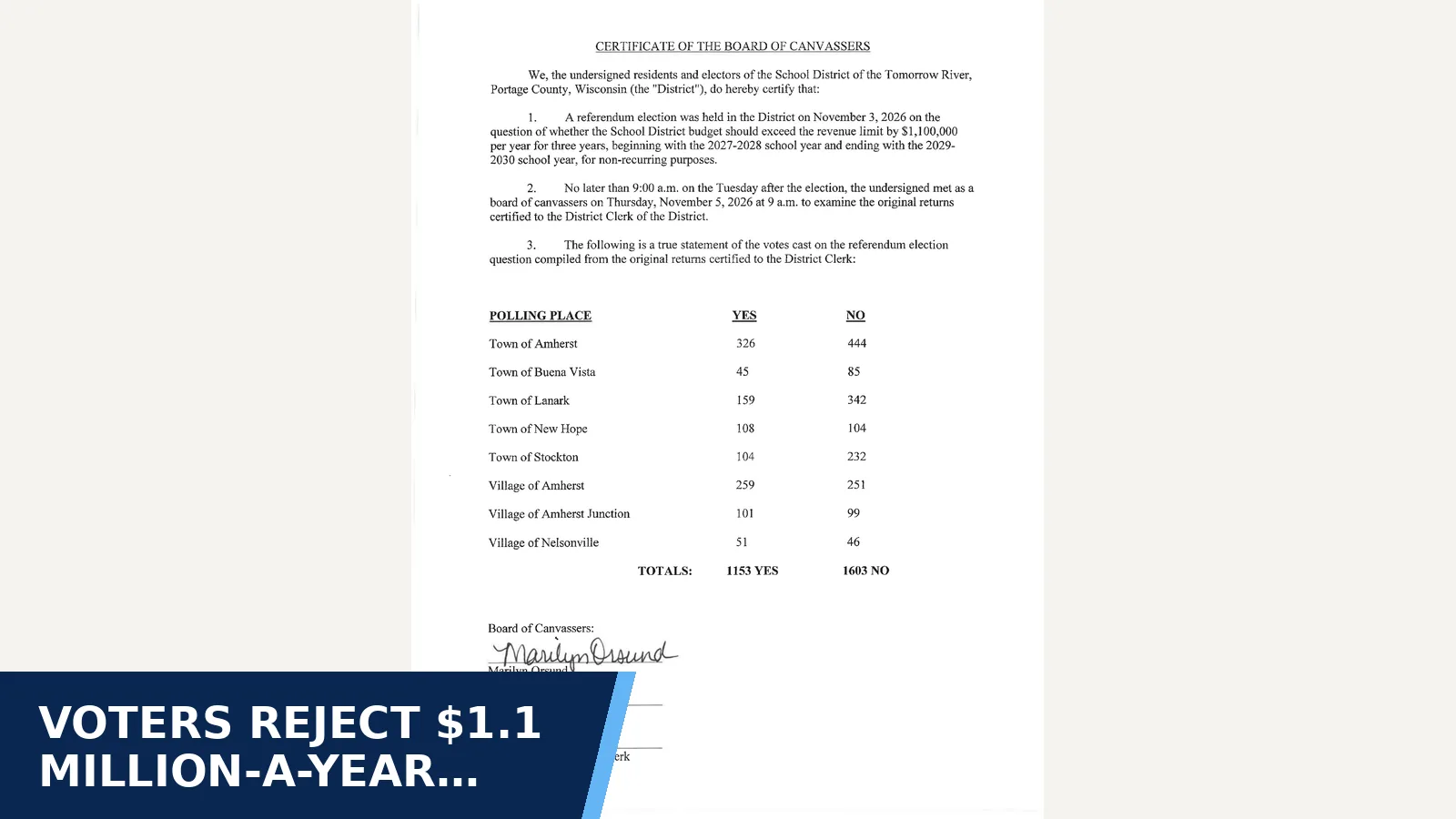
Tomorrow River voters rejected a referendum that would have allowed the district to exceed the state revenue limit by $1.1 million annually for three years, starting in 2027–28.
We bring transparency to school decisions nationwide by tracking school board meetings, district documents, and public data. We use AI tools, rigorously evaluated for accuracy, to search for risks.
The policy desk
What’s moving in phones
The debate over phones, screens and the school day.
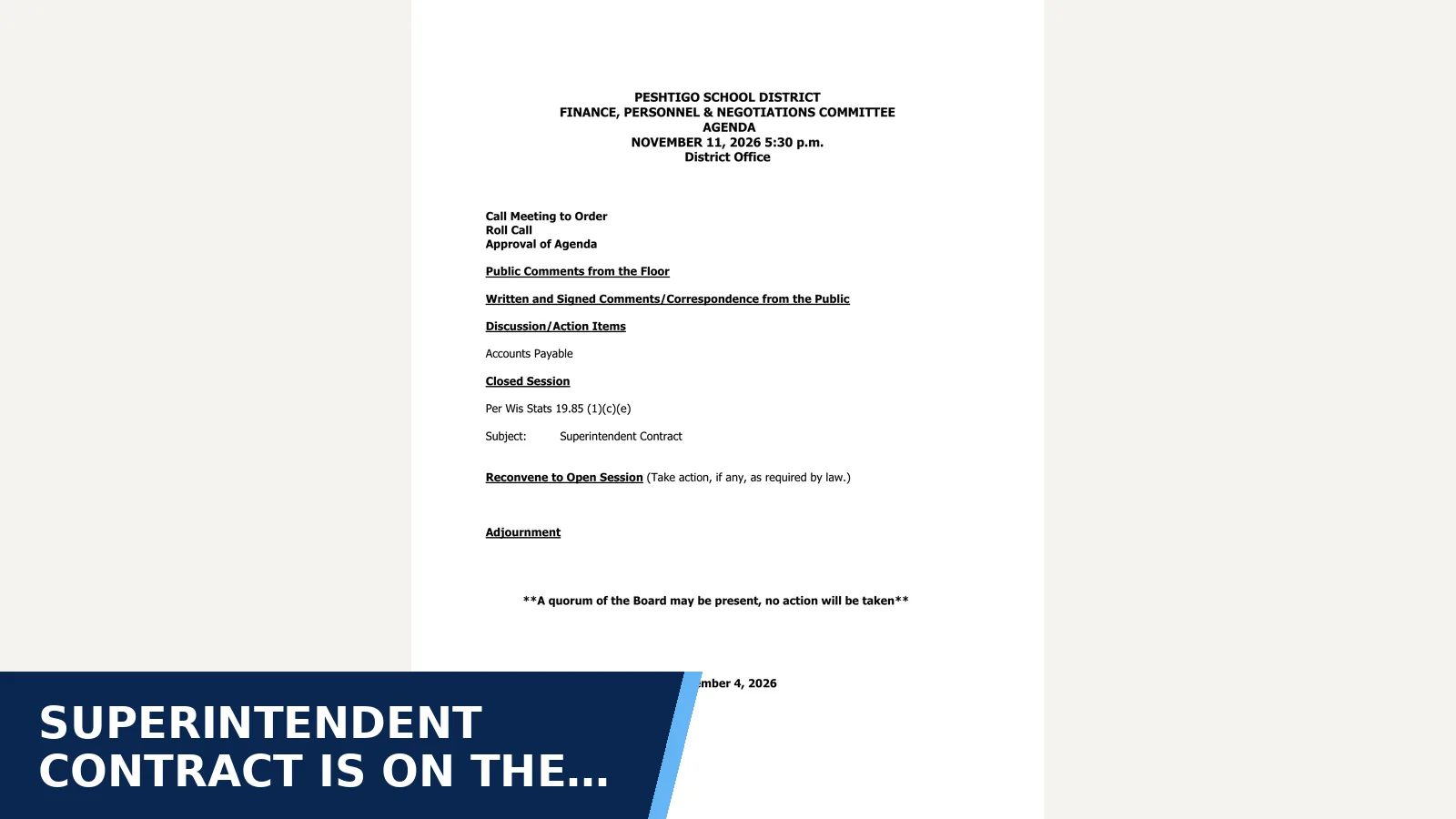
The finance, personnel and negotiations committee agenda for November 11, 2026 lists a closed session on the superintendent contract. The board held a closed-session superintendent evaluation on November 12, 2025 and a district administrator evaluation on June 24, 2026.
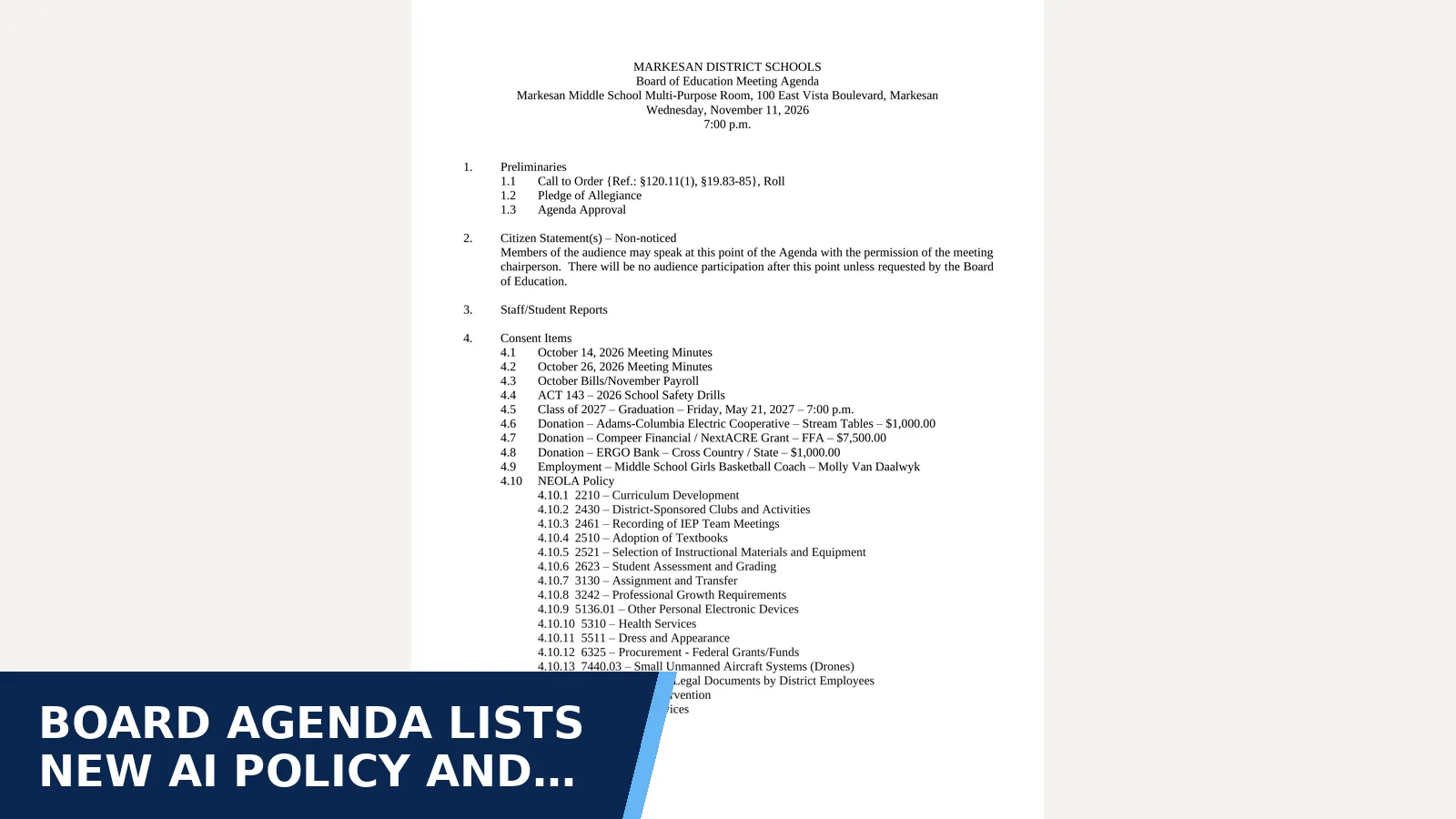
The November 11 agenda puts 44 policy updates on the consent list, including Personal Communication Devices (5136), Other Personal Electronic Devices (5136.01) and a new Artificial Intelligence policy (7540.08).
Administrators propose a $15 million bond anticipation note in December 2026, then long-term general obligation notes in spring 2027. The board is also asked to let Bray Architects start construction drawings, bidding and construction management for the work.
A student committee recommended replacing the high schools’ 4.0 GPA scale with a weighted 5.0 scale, giving added GPA weight to courses that meet proposed rigor criteria. The change would begin with the incoming ninth-grade class (Class of 2031), but the board did not approve it at this meeting; the committee said it would return with a final recommendation after further review.
The district plans to change the 2027-28 calendar so 4K students attend school on Oct. 20, 2027, with evening conferences. The update says 4K teachers and elementary principals no longer need morning conferences that day.
The board approved three new high school courses for 2027-28: Unified Physical Education, CAPP Personal Health & Wellness, and AP Seminar. CAPP Personal Health & Wellness can count toward students’ third required PE credit while offering college credit; Unified PE pairs students with and without special needs.
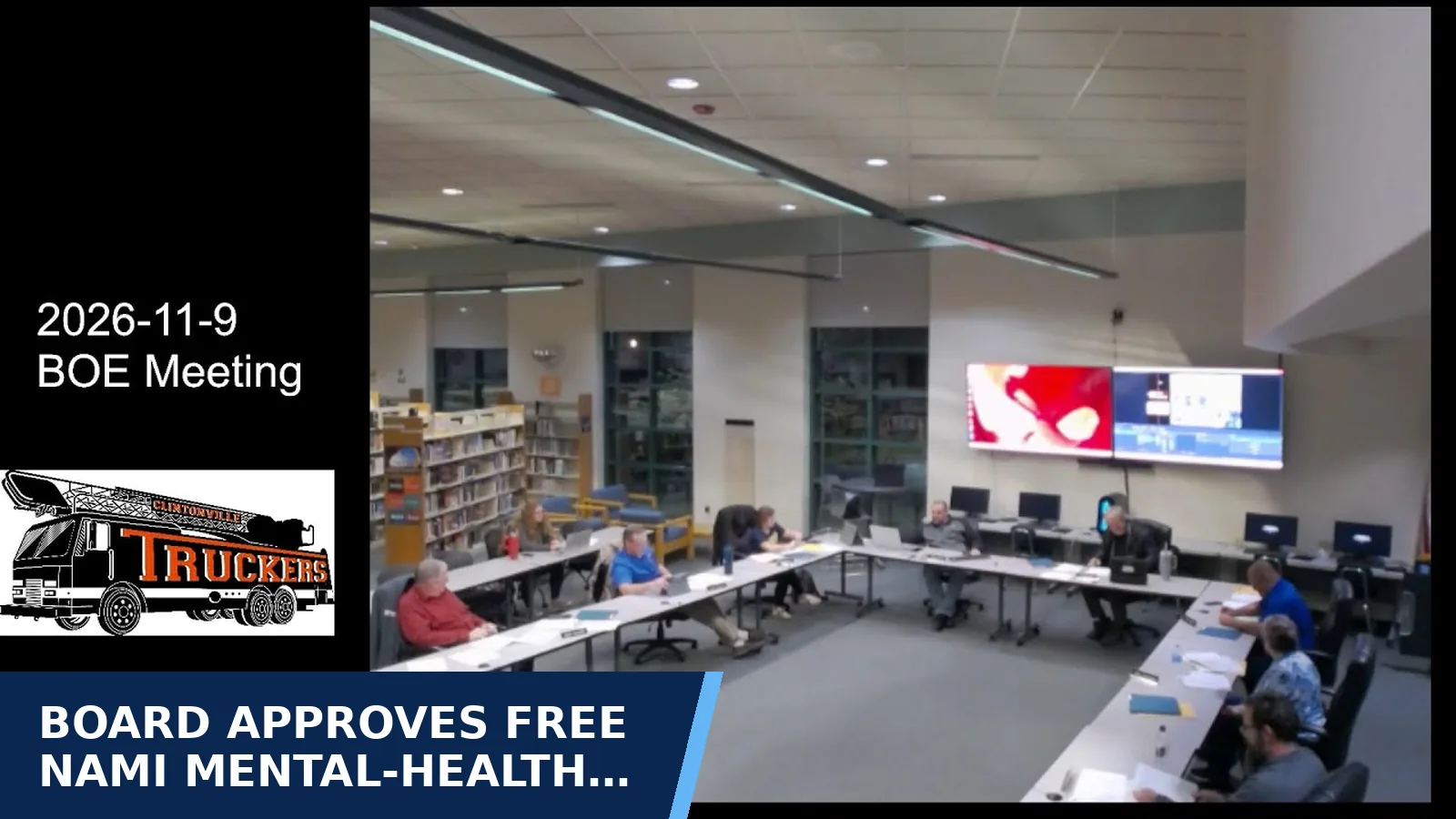
The board approved a partnership with the National Alliance on Mental Illness (NAMI) to provide age-appropriate mental-health education at designated grade levels. Approval was conditioned on the program being provided at no cost; the transcript does not name the grades.
The Nov. 9 board agenda lists Neola's Volume 35, No. 2 special update on artificial intelligence (AI) for consideration, after the Policy Committee reviewed the Neola AI toolkit on Nov. 3. The packet includes a proposed AI policy and administrative guideline.
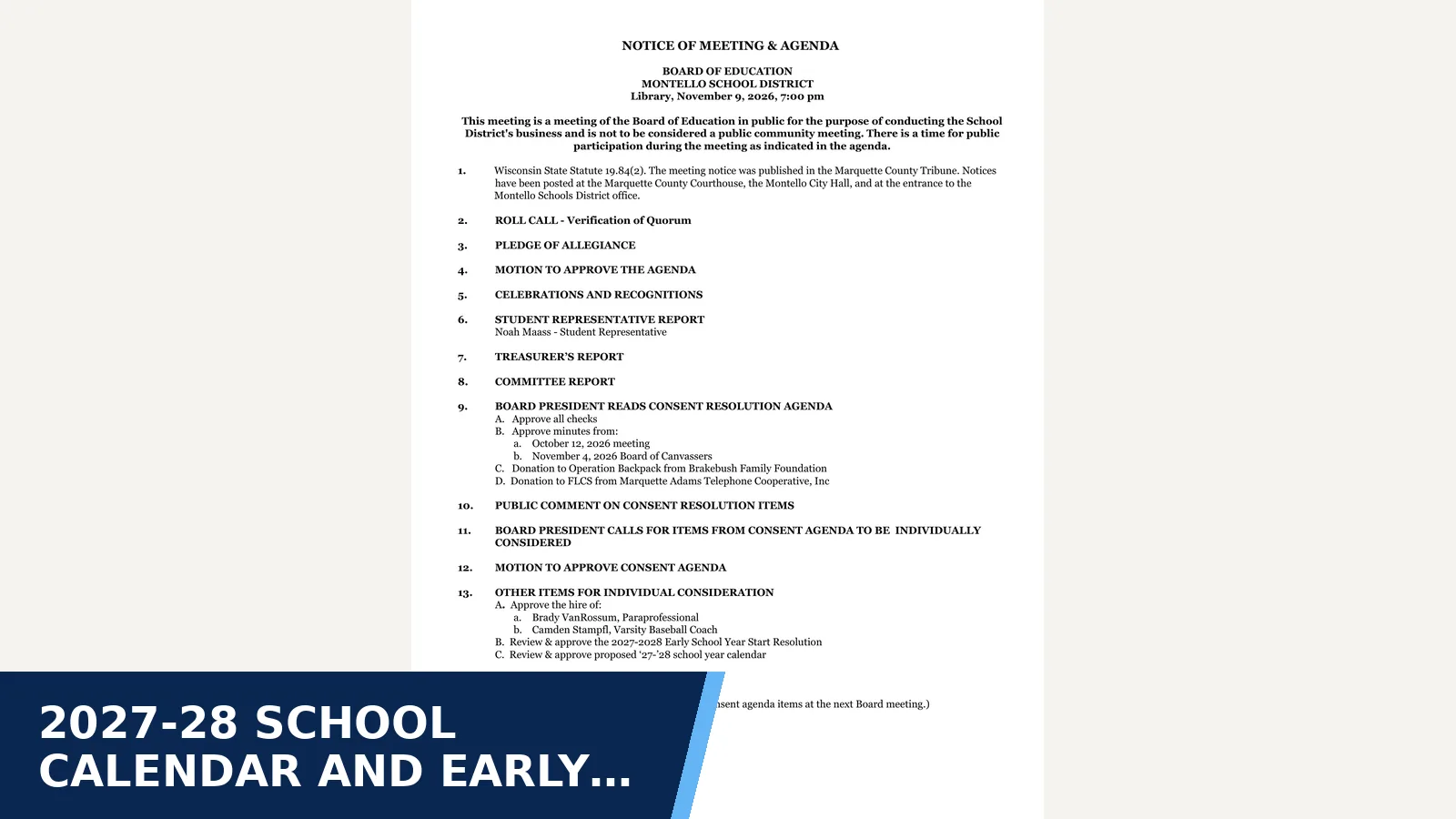
The November 9, 2026 agenda lists a resolution on an early start to the 2027-28 school year and the proposed 2027-28 calendar. A similar early start resolution for 2026-27 was on the November 10, 2025 agenda.
The board’s November 9 agenda schedules a public hearing and possible action on a proposed waiver concerning guaranteed admission and the use of the Laude system to identify the top 5% and 10% of graduates beginning with the class of 2029.
A community poll found 31% would vote for almost any school tax increase, 39% under some conditions and 30% against. Administration estimates a $20 a month increase would raise about $17.6 million, close to the $17.8 million deficit.
On Nov. 3 voters backed borrowing up to $100 million, with about 61% in favor in unofficial results. The money is for renovations at Pilgrim Park Middle (est. $50.4 million), Tonawanda Elementary ($33.7 million), Swanson Elementary ($9.5 million) and Wisconsin Hills Middle ($6.4 million).
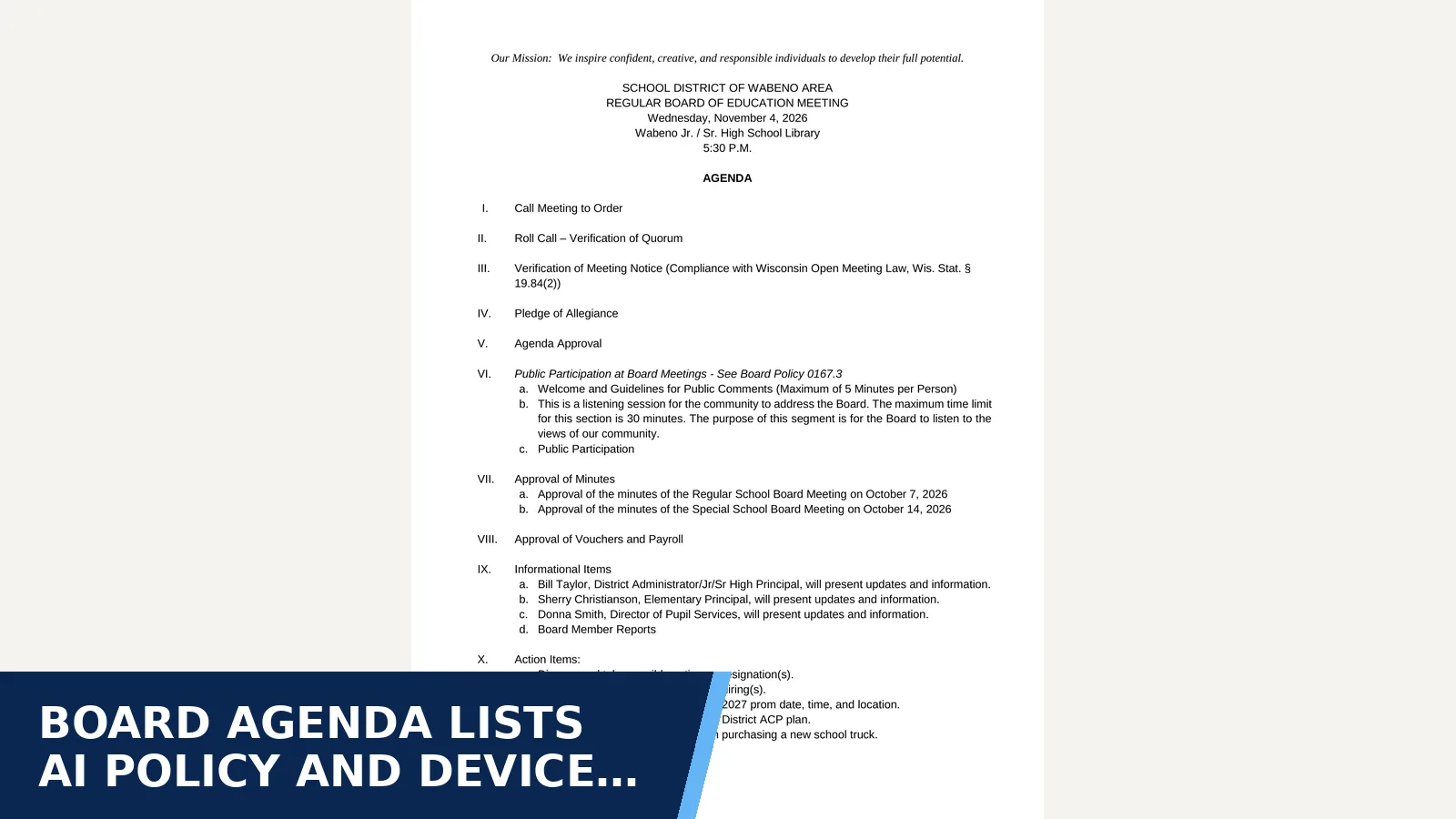
The November 4 agenda lists a special Neola update on Artificial Intelligence: policies 5136 (personal communication devices), 5505, 7440.02, 7540, 7540.03, 7540.04, 7540.08, 8310, 8315, 8330 and 8330.01. It also lists a nondiscrimination update and a new district strategic plan.
The board put a second operating referendum on the November 3, 2026 ballot: exceed the state revenue limit by $1.8 million a year for three more years (2027-29). The 2024 referendum that provides the same amount ends after 2026-27. Unofficial news reports after the vote say it passed 1,884 to 1,776.
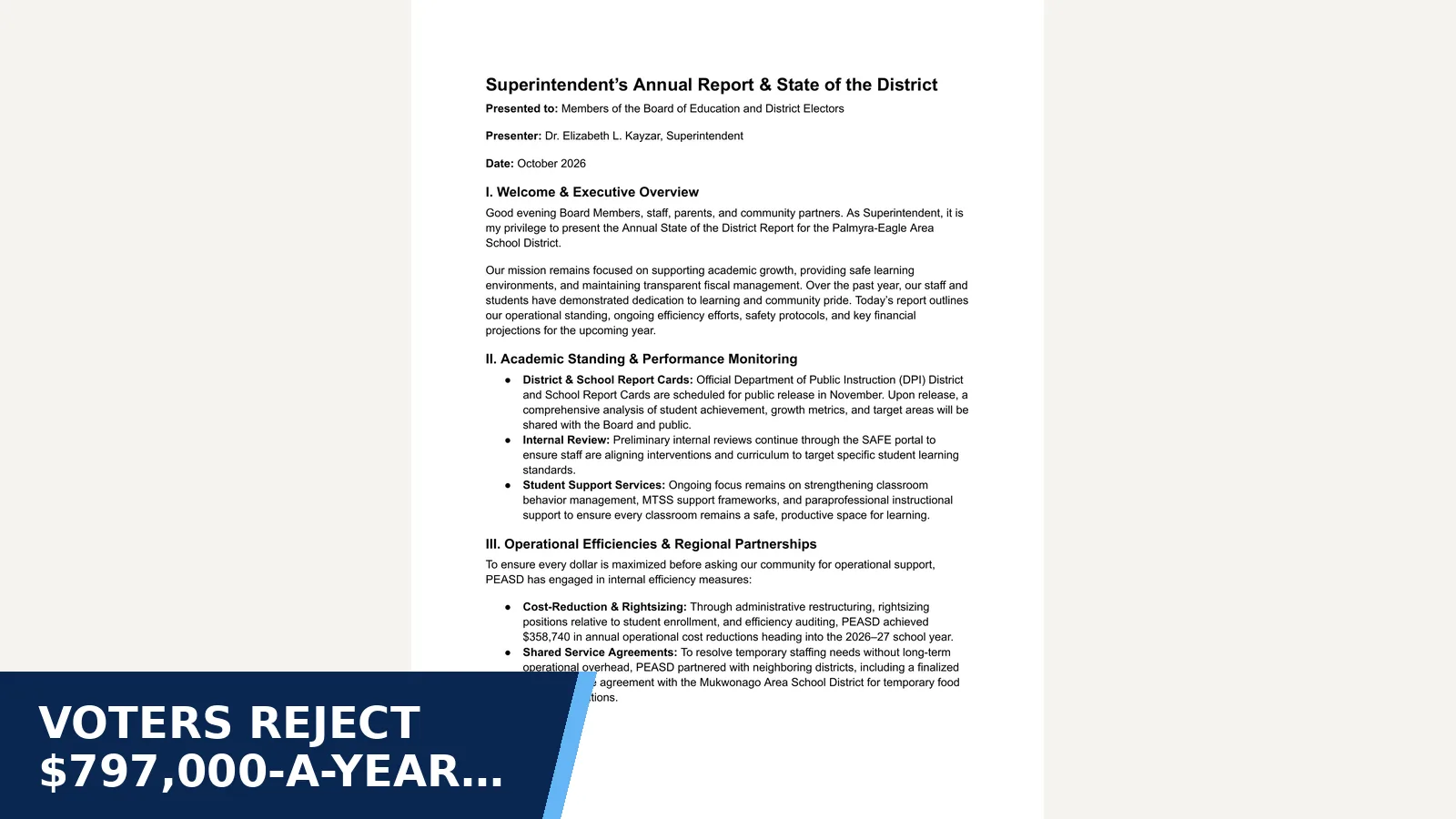
On Nov. 3, 2026 voters turned down a non-recurring operating referendum that would have let the district exceed the state revenue limit by $797,000 a year for four years. A news report gives 2,318 no votes (60.8%) to 1,497 yes; results were unofficial until canvassed.
The superintendent said enrollment over the last 10 years grew about 1.94%, but 2026-27 is estimated at 3,316 students, about 1.5% lower, and flat or declining enrollment is expected over the next five years because kindergarten classes are smaller than graduating classes.
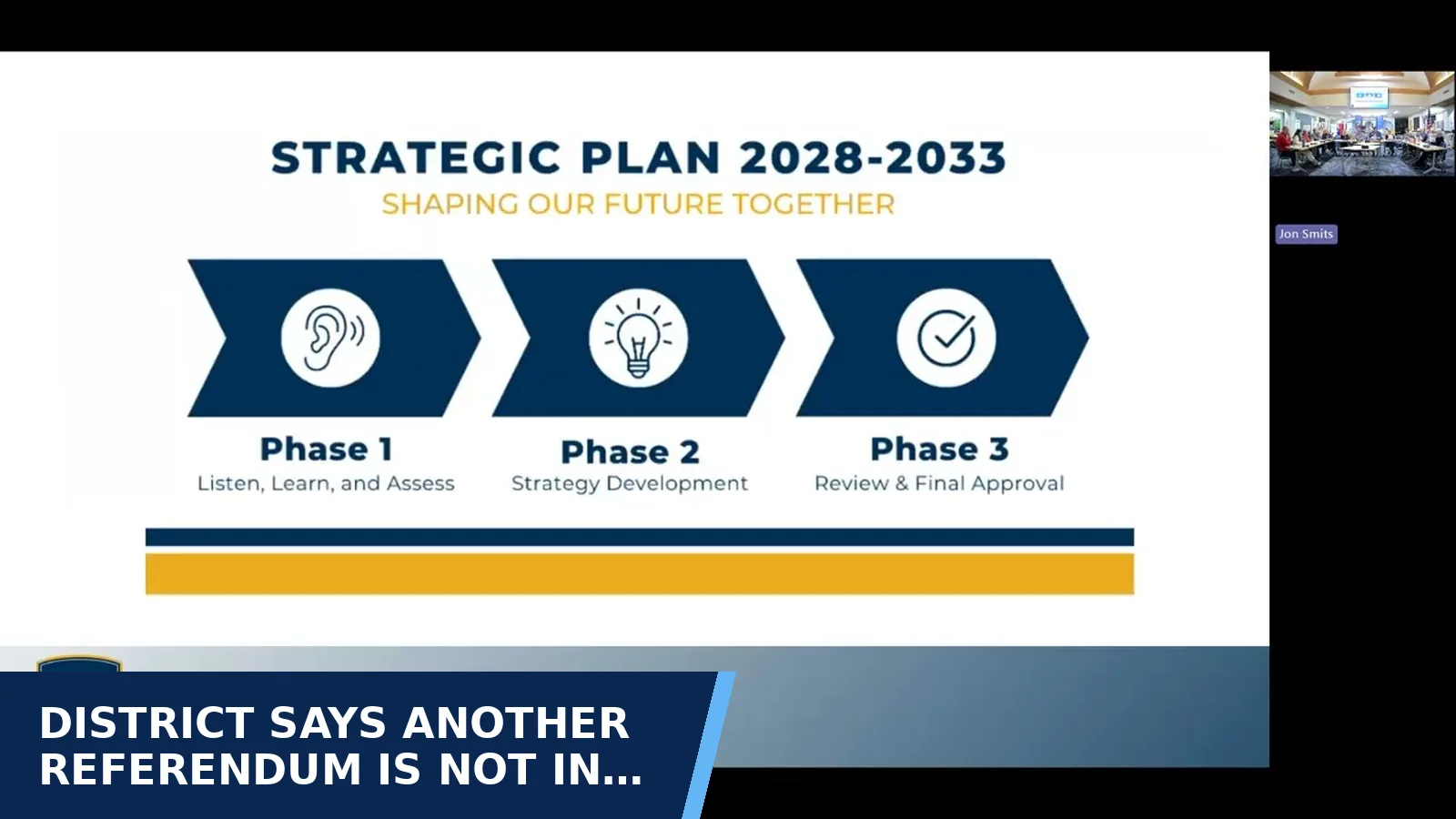
Officials said the 2024 operating referendum added $1 million to the revenue limit in each of 2024-25, 2025-26 and 2026-27, a permanent $3 million total, and that after 2026-27 only state per-student increases apply. With a capital referendum also passed, an additional referendum is not in the district's current reality.
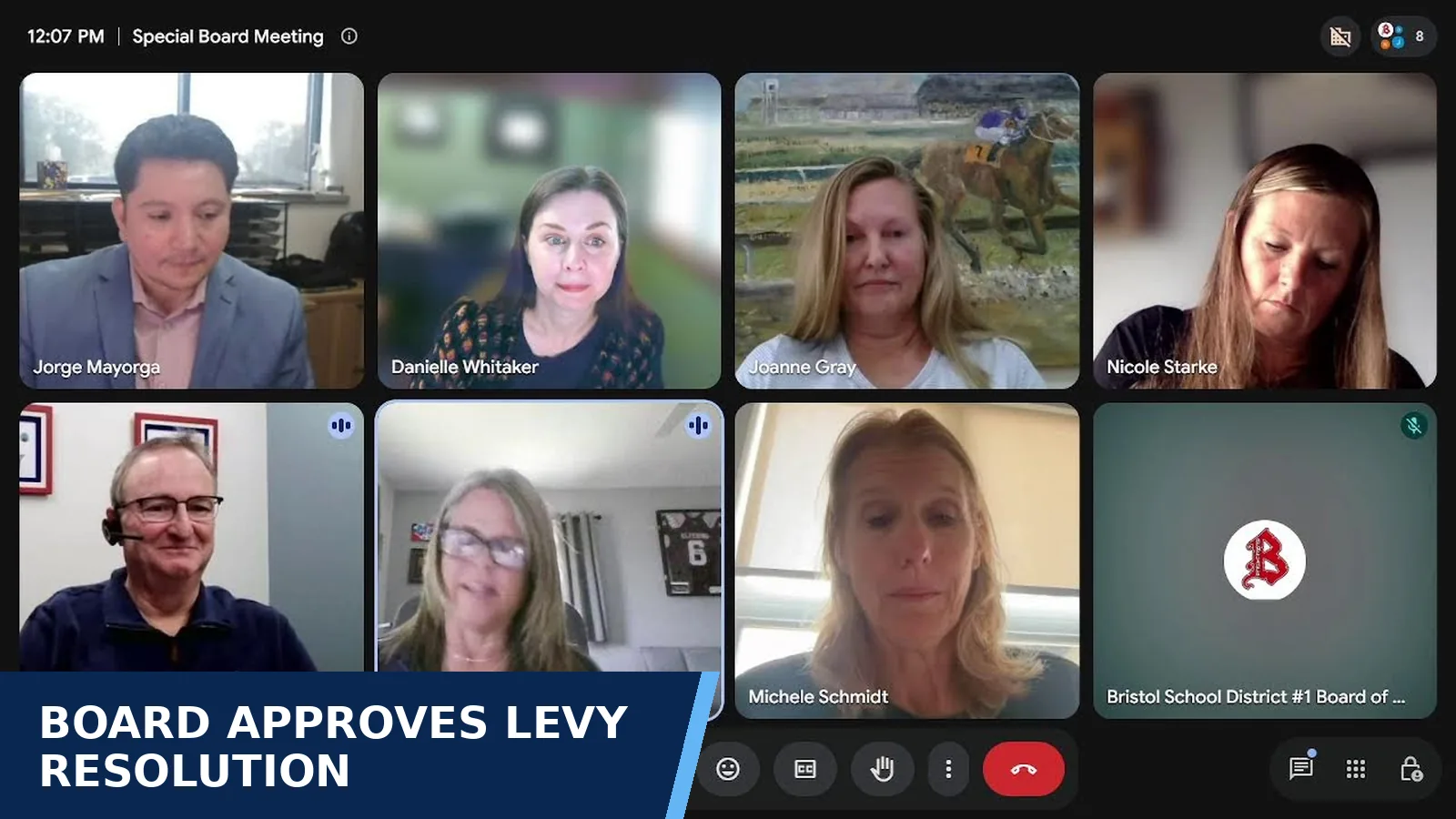
On October 30 the board approved a levy resolution stated in the recording as $7,790,453, after an October 21 presentation showed a preliminary $7,778,247 levy.
On October 29 the board set the district's property tax levy. Directors said about $77 million of the levy would be offset by the state school levy tax credit, and about $19.5 million goes to fund the state's special-needs scholarship program (a private-school voucher program), not MPS schools. The board also adopted an amended 2026-27 budget that day.
The superintendent reported on October 29 that 2026 Wisconsin Forward Exam English language arts proficiency rose across grades 3 through 8, with 23 schools improving by 5 percentage points or more. She also reported gains in math, science and social studies.
The board approved a revised 2026–27 budget and levy after a revenue-limit worksheet error was identified. The revised booklet lists a $35,307,484 levy.